Best First Aid Training Companies in the UK


When you're responsible for workplace compliance, choosing a first aid training provider means evaluating more than just who can get your staff certified—you're selecting who will prepare your team to respond effectively when a colleague's health or life depends on it. The UK market includes well-known charities, specialist independent providers, and everything in between, each with different pricing structures, trainer backgrounds, and delivery approaches that affect both your budget and how well your staff actually learn.
This guide compares the leading first aid training companies across the UK, explains which courses your workplace actually requires, breaks down the real costs of different booking models, and walks you through choosing a provider that matches your team's specific risks and learning needs.
Top 6 First Aid Training Companies in the UK
When you're looking for first aid training in the UK, you'll encounter well-established charities like St John Ambulance and British Red Cross alongside specialist independent providers. The best choice for your workplace depends on factors like group size, delivery preference, trainer background, and how you prefer to handle pricing.
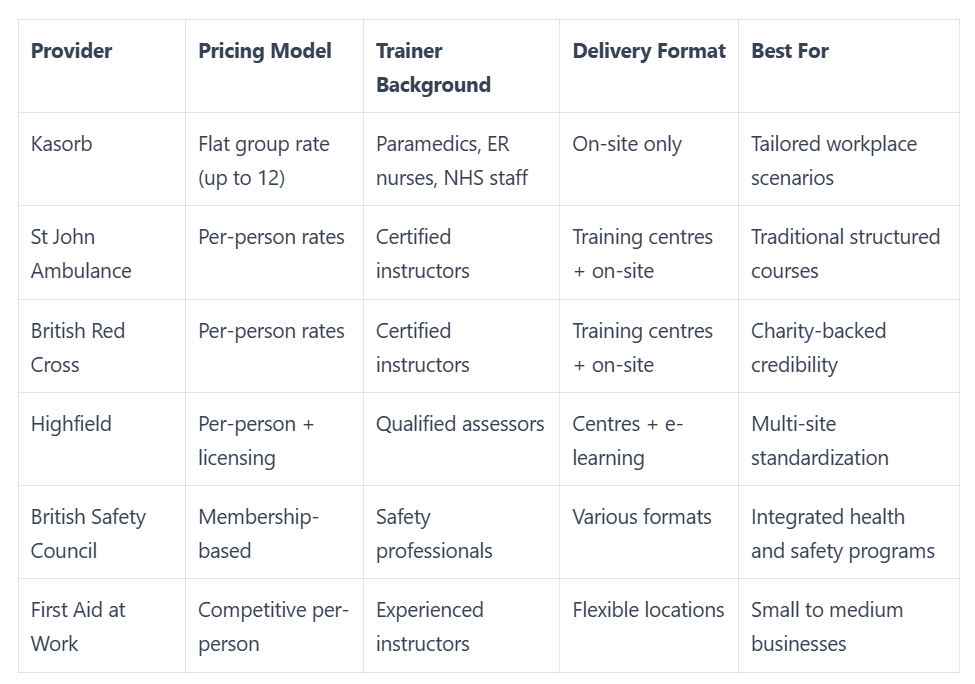
Here's how the leading providers compare:
Kasorb
Kasorb charges a flat group rate that covers up to 12 people, which means you pay the same whether you're training three staff members or twelve. All training happens on-site at your workplace, so instructors can tailor scenarios to your specific environment—a construction site looks very different from a care home or corporate office.
The trainers come from frontline medical backgrounds: paramedics who've worked emergency calls, ER nurses who've managed trauma cases, and NHS staff with years of clinical experience. Your team learns from people who've actually performed these interventions under pressure, not just taught them in a classroom. The approach focuses on hands-on practice with realistic scenarios that reflect the actual risks your staff might face.
St John Ambulance
St John Ambulance is the UK's oldest and largest first aid training charity, operating over 200 training venues nationwide. They offer both scheduled public courses that individuals can book into and bespoke workplace training delivered at your premises.
Their instructors follow standardized teaching methods that have been refined over decades. The organization's long-standing reputation gives many businesses confidence in their compliance credentials, though their trainers typically come from professional teaching backgrounds rather than active clinical practice.
British Red Cross Training
British Red Cross Training operates through a network of over 150 venues across the UK and co-authors the official UK First Aid Manual. They provide both accredited workplace courses that lead to HSE-recognized qualifications and non-certified public courses for general awareness.
The charity backing brings a strong community focus to their training. They're particularly well-known for their paediatric first aid courses in education settings, where their structured approach fits well with school and nursery environments.
Highfield
Highfield functions as both an awarding body and a training provider, which means they can offer integrated qualification pathways across multiple compliance areas. They've developed substantial e-learning components that allow staff to complete theory portions remotely before attending practical assessments.
This works well for organizations with multiple sites that want consistent, standardized training across all locations. Their focus on regulated qualifications makes them popular with larger employers who prioritize documentation and audit trails.
British Safety Council
British Safety Council operates on a membership model that bundles first aid training with broader health and safety resources, including risk assessment tools and policy templates. Their trainers typically come from occupational safety backgrounds rather than emergency medical services.
If you're looking to develop a comprehensive workplace safety program beyond just first aid compliance, their integrated approach might offer better value. However, the membership structure means you'll pay annual fees regardless of how much training you actually use.
First Aid at Work
First Aid at Work is an independent training provider with strong regional coverage across England and Wales. They offer flexible scheduling and competitive per-person pricing that appeals to smaller businesses without complex training requirements.
Their instructors are experienced and qualified, though you'll want to ask about their specific backgrounds when booking. The company focuses on straightforward, compliant training delivery without additional services or complexity.
Essential First Aid Courses for UK Workplaces
The Health and Safety Executive (HSE) doesn't mandate specific first aid qualifications for every workplace. Instead, they require employers to conduct a risk assessment and provide "adequate and appropriate" first aid provision based on what they find. What counts as adequate depends on your workforce size, the nature of your work, your workplace hazards, and your proximity to emergency medical services.
Most workplaces choose between three core course types, each designed for different risk levels and compliance requirements.
Emergency First Aid at Work (1-Day)
This one-day course covers immediate, life-preserving interventions: CPR, managing an unconscious casualty, controlling severe bleeding, and treating shock. It's designed for lower-risk environments like offices, retail spaces, or small workshops where serious injuries are unlikely.
The qualification allows someone to act as an "appointed person" who can take charge in an emergency and provide basic care until paramedics arrive. While it doesn't create a fully qualified first aider, it satisfies HSE requirements for many low-risk workplaces.
First Aid at Work (3-Day)
The three-day First Aid at Work course is the comprehensive qualification required for designated first aiders in higher-risk environments. It covers everything in the one-day course plus fractures and spinal injuries, burns and scalds, eye injuries, poisoning, anaphylaxis, heart attacks, strokes, asthma attacks, diabetic emergencies, and seizures.
This qualification is typically required in manufacturing, construction, warehousing, or any workplace where the risk assessment identifies significant injury potential. The course includes substantial practical assessment where you'll demonstrate competence in multiple scenarios.
Paediatric First Aid
Paediatric First Aid is mandatory for anyone working in registered childcare settings, nurseries, or schools in a supervisory capacity. Children respond differently to medical emergencies than adults do, and the techniques for CPR, choking intervention, and injury assessment all differ.
The course covers child-specific emergencies including febrile convulsions, croup, meningitis symptoms, and common childhood injuries. Even if you already hold an adult first aid qualification, you'll want this separate certification to work compliantly in childcare environments.
Mental Health First Aid
Mental Health First Aid has emerged as an important complement to physical first aid training, teaching staff to recognize signs of mental health crises and provide initial support. While it's not yet legally mandated for most workplaces, many organizations now include it as part of their wellbeing strategy.
The course covers depression, anxiety disorders, psychosis, substance abuse, and suicide risk. It equips staff to have supportive conversations and guide colleagues toward professional help, though it doesn't replace clinical mental health services.
First Aid Training Costs and Group Booking Comparison
First aid training costs vary significantly depending on the provider's pricing structure and the course type you want. Understanding these models helps you calculate the true cost for your team.
Per-person pricing typically ranges from £60 to £150 for Emergency First Aid at Work and £200 to £400 for the three-day First Aid at Work course. These rates usually include certification and course materials, but you might face additional charges for instructor travel if you're booking on-site delivery. When you're training small teams of two or three people, per-person pricing from public course providers often works out most economical.
Flat group rates charge a single fee regardless of whether you're training one person or twelve. This structure becomes significantly more cost-effective once you're training four or more staff members, and it removes the complexity of calculating per-head costs. For a team of ten, you might pay £600 per person with traditional providers (£6,000 total) versus a flat £1,500 group rate—that's substantial savings.
Some providers also charge separately for certificates, trainer travel expenses, or course materials. Always ask for the all-inclusive price before committing. Membership-based organizations like British Safety Council spread costs across annual fees, which might offer value if you're running multiple training types throughout the year but can feel expensive if you only want occasional first aid courses.
On-Site Training vs Training Centre Venues
Choosing between on-site workplace delivery and attending a training centre affects more than just convenience—it influences how effectively your team learns and retains practical skills.
On-site training brings the instructor to your workplace, allowing them to build scenarios around your actual environment and equipment. Your staff practice CPR in the room where they'd actually perform it, learn to navigate your specific layout during emergencies, and work with colleagues they'd genuinely be supporting in a crisis. There's no travel time, no taking half-days off to attend external venues, and no logistical complexity of coordinating multiple staff absences. However, workplace distractions can sometimes interrupt training flow, and you'll want to provide adequate space for practical exercises.
Training centre venues offer dedicated facilities with purpose-built training rooms, proper manikins, and an environment designed specifically for learning. You'll avoid workplace interruptions, and your staff might engage more fully when they're physically removed from their daily responsibilities. The downside is travel time, the effort to coordinate staff absences, and scenarios that feel less directly relevant to your specific workplace.
Most businesses with teams of six or more find on-site delivery more practical and cost-effective. Individuals or very small teams often prefer the scheduled convenience of training centre courses.
Trainer Qualifications Across Different Providers
All first aid instructors in the UK hold a recognized qualification—typically the Level 3 Award in Education and Training (or equivalent) plus a first aid instructor certificate from an approved awarding body. But these baseline qualifications don't tell you much about what your team will actually experience in the training room.
The meaningful difference lies in the instructor's background before they became a trainer. Some providers primarily employ professional educators who've built careers in training delivery—they're excellent at classroom management and teaching techniques, and they know the curriculum thoroughly. Others, like Kasorb, specifically recruit instructors from active or recent clinical practice: paramedics who've responded to thousands of emergency calls, ER nurses who've managed trauma cases, intensive care specialists who've performed these interventions regularly under pressure.
Clinical experience changes how instructors teach because they can draw on real cases, explain why certain techniques work better in practice than in theory, and help learners understand what an actual emergency feels like. When a paramedic explains how to assess an unconscious patient, they're describing something they've done repeatedly in unpredictable, high-stress situations—not just something they've read in a manual.
You might also want to ask about instructor-to-learner ratios for hands-on practice. The best learning happens when everyone gets substantial time practicing on manikins with direct instructor feedback, which becomes difficult when one instructor is managing groups larger than twelve.
First Aid Training London and Major UK Cities
Geographic location affects both the availability of training options and how quickly you can book courses, particularly if you want urgent compliance training.
First Aid Courses London
London has the highest concentration of first aid training providers in the UK, with multiple training centres in every borough and dozens of mobile instructors available for on-site delivery. You'll find daily scheduled courses across all qualification types, making it easy to slot individual staff members into public courses at short notice.
For on-site first aid training London businesses typically have access to same-week or next-week availability, even for full three-day First Aid at Work courses. The competitive market also means pricing tends to be more favorable than in less densely served regions.
Birmingham and Manchester Training Options
Birmingham and Manchester both have strong regional coverage from national providers plus well-established local training companies. You'll find multiple training centres in each city and good availability for on-site delivery throughout the surrounding metropolitan areas.
Scheduled public courses run several times per week for common qualifications like Emergency First Aid at Work. You might wait a week or two for three-day courses, though. The major business districts—Birmingham city centre, Manchester's Spinningfields and Salford Quays—have particularly good coverage for workplace training.
Scotland and Northern Ireland Coverage
Scotland and Northern Ireland have slightly different training landscapes, with some national providers operating fewer venues outside major cities. Edinburgh, Glasgow, Belfast, and Aberdeen have good availability, but businesses in more remote areas might find their options limited to regional providers or face longer wait times for on-site delivery.
Scotland's qualifications framework operates through the Scottish Qualifications Authority (SQA) rather than Ofqual, though the practical training content remains aligned with HSE guidance. This rarely affects workplace compliance but can matter if you're operating across borders and want consistent qualification types.
Regulatory Compliance and Certification Standards
Understanding UK first aid regulations helps you verify that your chosen training actually meets your legal obligations—and that the certificates your staff receive will satisfy HSE inspectors or industry regulators.
The HSE doesn't "approve" individual training providers or courses. Instead, they publish guidance on what constitutes adequate first aid training, and they expect certificates to come from competent, qualified instructors. What most providers mean when they say "HSE-approved" is that their course content aligns with HSE guidance and their certificates meet the standards HSE expects.
Awarding bodies like Ofqual (England and Wales), SQA (Scotland), and Qualifications Wales provide the actual regulatory oversight. When a training provider says they're accredited by Qualsafe, First Aid Awards, or another awarding body, this means that organization has verified their course content, assessment methods, and quality assurance processes.
First aid certificates are valid for three years from the date of issue, after which your staff complete a requalification course. These requalification courses are typically shorter than initial training—often two days instead of three for First Aid at Work—but they're mandatory to maintain valid first aider status. Some providers offer annual refresher sessions to help staff maintain skills between certifications, though these don't extend certificate validity.
How to Choose the Right First Aid Training Provider
Selecting a first aid training provider involves more than comparing prices—you're choosing who will equip your team with skills they might use to save a colleague's life.
Step 1: Assess Your Workplace Requirements
Start by conducting an HSE-compliant risk assessment that examines your workplace hazards, workforce size and distribution, shift patterns, and proximity to emergency services. A small office with twenty staff working 9-5 in a city centre has very different requirements than a manufacturing facility with sixty staff across three shifts in a rural location.
Your risk assessment determines how many first aiders you want (not just appointed persons), which qualification levels are appropriate, and whether you want specialist training like paediatric first aid. HSE guidance provides clear frameworks for making these determinations.
Step 2: Compare Group Pricing Options
Calculate the total cost including all fees: training delivery, instructor travel, course materials, and certification. For teams of one to three people, per-person rates at public courses often work out most economical. For four or more staff, flat group rates typically offer better value—sometimes dramatically so.
Consider your annual training requirements too. If you're training new starters regularly or running refresher courses, some providers offer better rates for ongoing relationships.
Step 3: Verify Trainer Credentials
Ask potential providers about their instructors' backgrounds beyond basic teaching qualifications. Do they come from clinical practice, emergency services, or professional training careers? How much hands-on experience do they have with the interventions they're teaching?
Also confirm the instructor-to-learner ratio for practical exercises. Everyone benefits from substantial practice time with manikins and direct feedback—if you're booking on-site training for twelve people, you'll want to know whether one instructor can effectively manage that group or whether they'll bring an assistant.
Step 4: Check Certification Validity
Confirm that certificates will meet HSE requirements and be accepted by any industry-specific regulators you answer to. Verify which awarding body accredits the course and check that they're recognized by the appropriate qualifications authority (Ofqual, SQA, or Qualifications Wales).
Ask about certificate format too—some employers prefer physical certificates, others want digital copies for their compliance management systems. Understand when requalification becomes necessary and whether the provider offers ongoing support for maintaining your first aid provision.
Making First Aid Training Work for Your Business
Getting your team trained is only part of building effective first aid provision—you also want to think about scheduling, skill maintenance, and integration with your broader safety culture.
Schedule training strategically to minimize operational disruption. For businesses that can't easily release multiple staff simultaneously, consider splitting teams across two sessions or running training during quieter periods. On-site delivery gives you more flexibility here since you're not constrained by training centre availability.
Skills fade without practice, so consider how you'll maintain competence between three-year requalifications. Some providers offer annual refresher sessions that don't lead to new certificates but keep techniques fresh in your team's minds. You might also conduct internal scenario practice or tabletop exercises where first aiders talk through their response to hypothetical emergencies.
First aid training works best when it's part of a broader health and safety culture rather than isolated compliance activity. Connect your first aid provision to risk assessments, emergency procedures, and incident reporting systems. Make sure first aiders know where equipment is stored, how to access emergency services from your premises, and what documentation they'll complete after providing care.
Kasorb's approach recognizes these practical realities by building training around your specific workplace scenarios and risks. When instructors tailor exercises to your actual environment—your layout, your equipment, your common hazards—staff develop skills they can genuinely apply rather than generic techniques they'll struggle to adapt. If you're ready to book practical, hands-on first aid training tailored to your workplace, Book Training Instantly and get your team compliance-ready with instructors who bring real emergency experience to every session.
Frequently Asked Questions about First Aid Training
How much does workplace first aid training cost in the UK?
Costs vary significantly by provider and course type. Per-person rates typically range from £60-£150 for one-day Emergency First Aid at Work and £200-£400 for three-day First Aid at Work courses, while flat group rates for up to 12 people often range from £800-£1,500 depending on course length and provider. Always confirm whether quoted prices include instructor travel, materials, and certification.
Are online first aid courses legitimate in the UK?
Online theory components are acceptable for some blended learning courses where you complete knowledge elements remotely before attending in-person practical sessions. However, fully online first aid courses don't meet HSE requirements for workplace compliance because first aid qualifications require assessed practical competence with hands-on skills that can't be evaluated remotely.
How often must first aid certificates be renewed in the UK?
Emergency First Aid at Work and First Aid at Work certificates are valid for three years from the date of issue. Staff complete a requalification course before their certificate expires to maintain valid first aider status—allowing certificates to lapse means they're no longer qualified and you're potentially non-compliant until they retrain.
What's the difference between an appointed person and a first aider in UK workplaces?
An appointed person takes charge when someone is injured or becomes ill, calls emergency services, and manages first aid arrangements, but they're not required to hold a first aid qualification or provide treatment beyond very basic care. A first aider holds a valid HSE-recognized certificate (typically First Aid at Work or Emergency First Aid at Work) and is qualified to assess casualties and provide appropriate treatment while waiting for emergency services.


Book a free 15-min consult call with us. We’ll help you get your mandatory training done right.