

CQC Training Gap Index 2026: What Inspectors Found About Staff Training in Care Homes
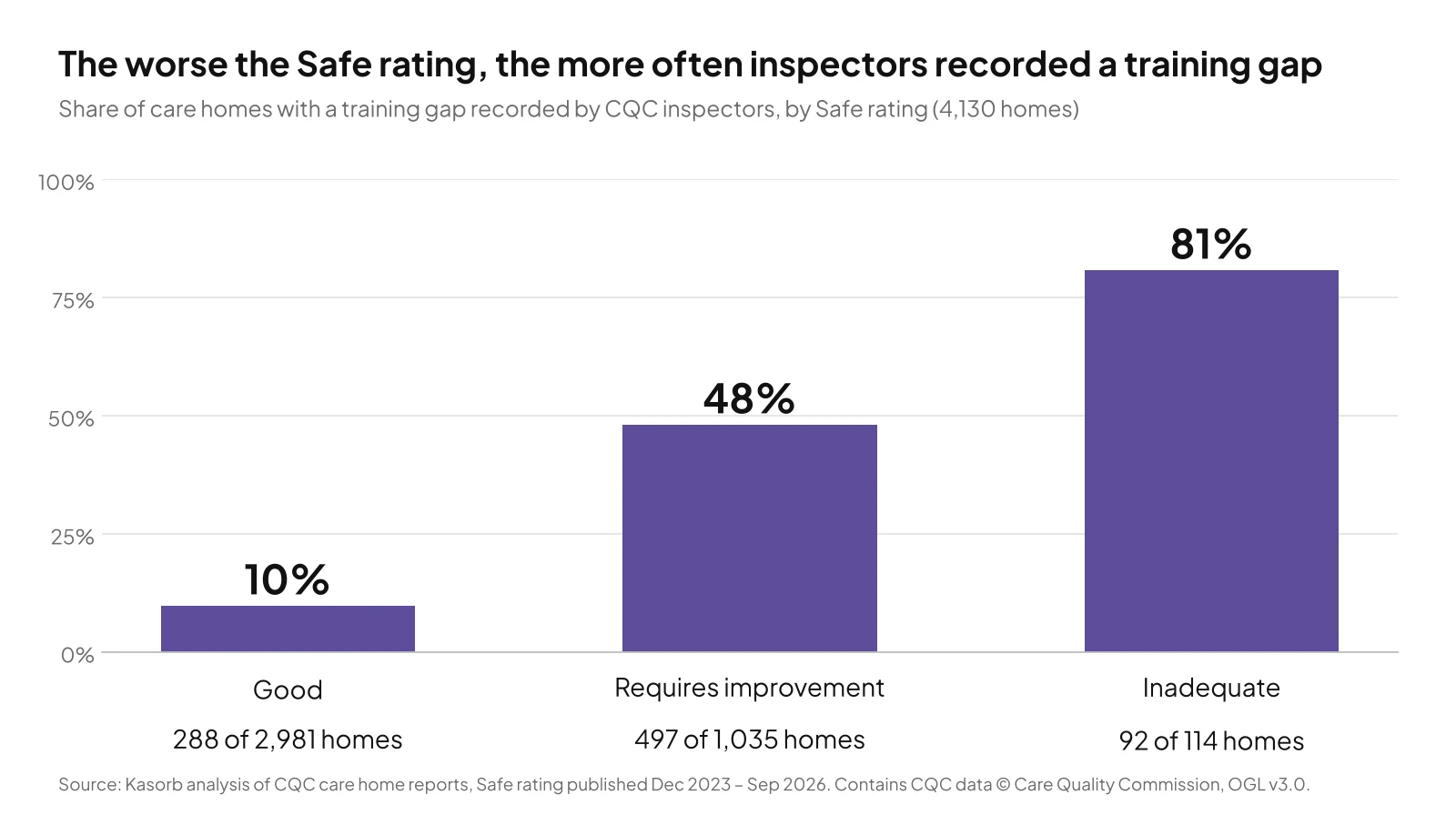

We read what CQC inspectors wrote about staff training in the latest reports for 4,146 care homes rated for safety since December 2023. The worse a home's Safe rating, the more often inspectors recorded a training gap: about 1 in 10 homes rated Good, half rated Requires improvement and 8 in 10 rated Inadequate.
Key findings
- Across all 4,146 care homes, inspectors recorded a staff training gap in 21% (878). Including homes where staff had done the training but weren't applying it, the figure is 23% (957), nearly 1 in 4.
- Only 2% of care homes rated Outstanding overall had a staff training gap recorded (3 of 139), against 78% of those rated Inadequate overall (67 of 86).
- Inspectors recorded a training gap in 81% of care homes rated Inadequate for Safe (92 of 114).
- Inspectors recorded a training gap in 48% of care homes rated Requires improvement for Safe (497 of 1,035).
- Among homes rated Good for Safe, inspectors recorded a training gap in about 1 in 10 (288 of 2,981).
- Medicines training and competency was the most common named gap at every rating: in 29% of Inadequate homes with a gap, 27% rated Requires improvement and 16% rated Good.
- In 1 in 5 homes rated Inadequate for Safe (24 of 114), inspectors found staff had done the training but were not putting it into practice.
- The lower CQC scored a home for "safe and effective staffing", the more often a training gap was recorded: 73% at score 1, 56% at score 2 and 21% at score 3 (homes rated Requires improvement).
What training was missing
Medicines training and competency checks came first at every rating: 29% of Inadequate homes with a gap, 27% rated Requires improvement and 16% rated Good. In Inadequate homes, induction not done or not recorded came next (22%), then moving and handling (21%) and safeguarding (18%).
In homes rated Good, gaps were more often general compliance points, such as some refresher training being overdue (31% named no subject), then medicines (16%), learning disability and autism (9%) and induction (8%).

More detail: what inspectors found about medication training.
Trained but not applied
Inspectors often found the certificate was there but the practice wasn't: in 169 homes in all, including 24 rated Inadequate, 117 rated Requires improvement and 28 rated Good. Example wording from CQC reports (no home named):
- "Records demonstrated that staff had completed dementia training, but most staff we spoke with lacked basic underpinning knowledge…"
- "Although staff had received training in infection prevention and control (IPC), we observed standards of cleanliness were not consistently…"
- "Staff had completed Moving and Handling training, however, we observed that some staff did not support people with their moving and handling needs in…"
CQC rarely says why training didn't transfer, so we don't either. What the reports do show is where the checks were missing: observation of practice, supervision and refreshers. More detail: when care home training doesn't show on the floor.
Homes rated Good
A Good rating doesn't mean inspectors found nothing to fix. About a third of the gaps in Good homes were general compliance points, and about a third were training for the specific needs of people living there, such as epilepsy, dysphagia, diabetes or positive behaviour support. More detail: training gaps in care homes rated Good.
By region
Share of care homes with a training gap recorded by inspectors, all ratings, then homes rated Good or Outstanding only:
- North West: 33% of 440 homes; Good or Outstanding 13% of 247
- East of England: 24% of 411; Good or Outstanding 8% of 263
- South East: 22% of 825; Good or Outstanding 9% of 595
- Yorkshire and the Humber: 21% of 454; Good or Outstanding 10% of 322
- West Midlands: 20% of 383; Good or Outstanding 11% of 266
- South West: 19% of 557; Good or Outstanding 12% of 464
- East Midlands: 19% of 484; Good or Outstanding 10% of 367
- North East: 15% of 217; Good or Outstanding 6% of 170
- London: 12% of 354; Good or Outstanding 6% of 286
Much of the difference between regions comes from how many homes in each region are rated Requires improvement or Inadequate. Comparing homes with the same rating, regions are much closer. Local authority figures, with confidence intervals, are in the download below for areas where we read at least 50 homes.
Homes still waiting
127 homes rated Requires improvement for Safe have only an older-format report from 2022 to 2024 and no assessment under CQC's current framework. In those reports, inspectors recorded a training gap in 31% (40 of 127). Many will have fixed what was found but can't yet show it.
What managers can do
Built from what inspectors wrote, not from Kasorb's courses. Download the free one-page checklist (PDF).
- Training matrix up to date, with completion and expiry dates for every member of staff, including bank and agency staff.
- Medicines competency assessments in date for everyone who gives medicines, with observed practice recorded.
- Induction completed and signed off before new or agency staff work unsupervised.
- Refresher dates set for moving and handling, safeguarding, fire, first aid and infection control.
- Specialist training in place where people's care plans need it (epilepsy and rescue medicine, dysphagia, catheter care, diabetes, positive behaviour support).
- Learning disability and autism training at the right level for each role, required since July 2022.
- Checks that training shows up in practice: observations, supervision notes, spot checks.
How we did it
- Took every care home in CQC's ratings data (October 2026) whose Safe rating was published between December 2023 and September 2026: 4,146 homes across all ratings with a current-format report.
- Read the Safe and Effective pages of each home's latest report on cqc.org.uk, and pulled every sentence mentioning training, competence, induction, refreshers, e-learning or mandatory training.
- Coded each home: a training gap recorded by inspectors; staff trained but not applying it; or only staff or relatives saying training was lacking (reported separately).
- Checked the coding: repeat blind coding of 401 homes by a second coder who couldn't see the first codes (agreement 92–100%), and a hand check of 10 homes by Kasorb's founder (10 of 10 agreed).
- Checked the rest of the report: for 150 homes drawn at random across all ratings, we also read the Caring, Responsive and Well-led pages. Only 3 (2%) recorded a staff training gap that wasn't already on the Safe or Effective pages, so the figures here, if anything, slightly undercount.
Limits. Reports cover what inspectors chose to write about, so no training finding doesn't prove training was fine. Requires improvement doesn't mean unsafe. The data shows where gaps were recorded, not that they caused a rating. England only. Homes whose latest report is in the older format (417) are left out of the headline figures.
Data and credits
- Download the data (CSV): figures by rating, subject, region and local authority. No home is named.
- Cite as: Kasorb (2026), CQC Training Gap Index 2026, kasorb.com/blog/cqc-training-gap-index. Reports read 20–22 October 2026.
- Contains CQC data and report text, © Care Quality Commission, used under the Open Government Licence v3.0.
- Author: Steve van de Worp, founder, Kasorb.
FAQs
What is the most common training gap CQC finds in care homes?
Medicines training and competency checks: the most common named gap at every rating, in 23% of all homes with a gap.
Do care homes rated Good have training gaps?
Some do. Inspectors recorded a training gap in about 1 in 10 homes rated Good for Safe (288 of 2,981).
What does "trained but not applied" mean?
Inspectors found staff had completed training but didn't understand it or follow it in practice.
Does a training gap mean a home is unsafe?
No. It means inspectors recorded a shortfall in training, competency checks or induction at that assessment.
Can I see the results for my area?
Yes. This page has a figure for each English region, and the download includes local authorities where we read at least 50 homes.
Will this be updated?
Yes, every year, at the same address.
On-site training for your whole team at one flat rate. See what's covered, prices and how to book.
See the course

Not sure which course your team needs? Tell us about your setting and we'll confirm within 48 hours.