

Trained but Not Applied: When Care Home Training Doesn’t Show on the Floor
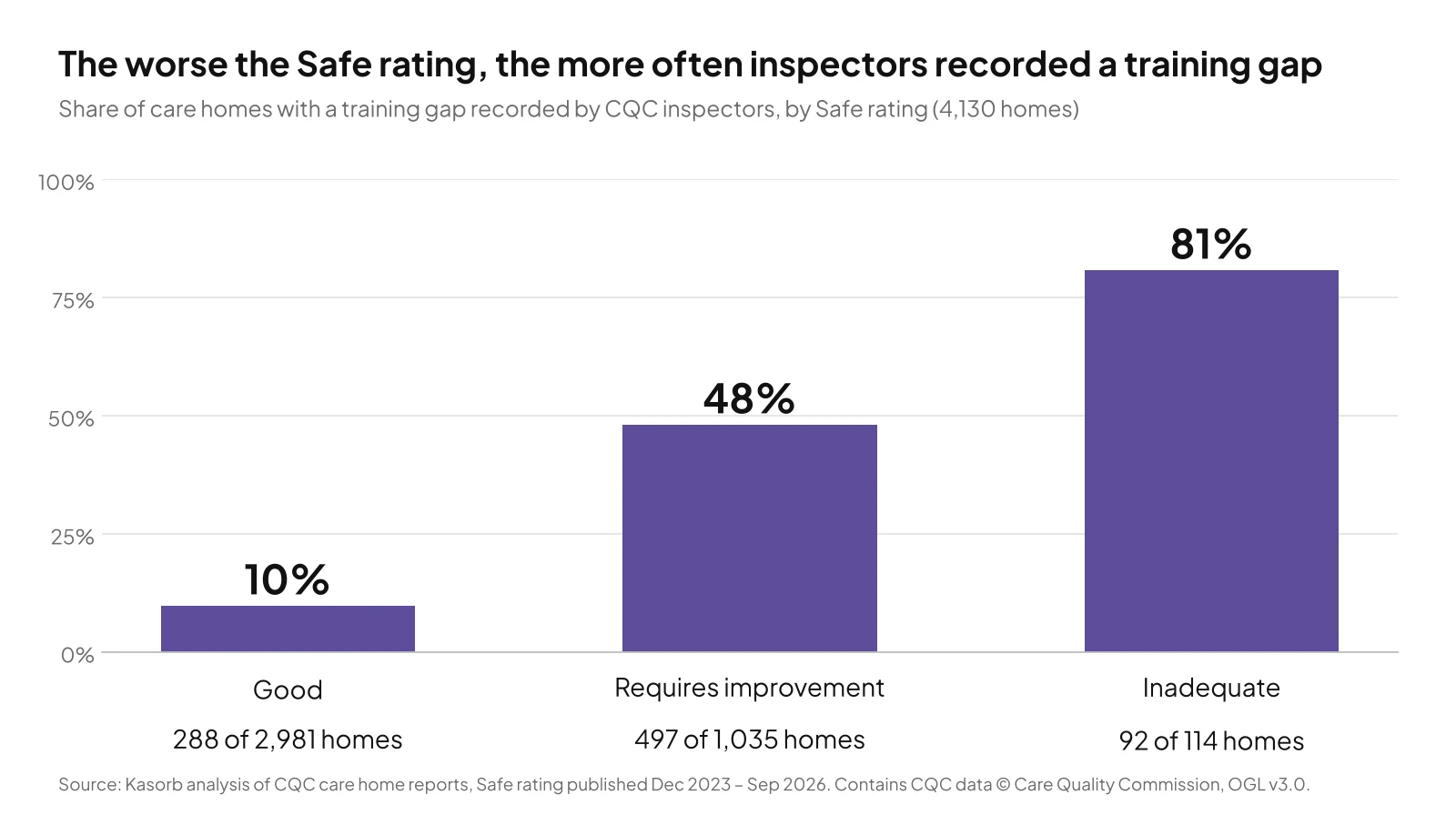

Part of the CQC Training Gap Index 2026, Kasorb's analysis of what CQC inspectors wrote about staff training in care home reports.
In 1 in 5 care homes rated Inadequate for Safe (24 of 114), CQC inspectors found staff had completed their training but weren't putting it into practice. In homes rated Requires improvement it was about 1 in 9 (117 of 1,035), and even in homes rated Good it came up in 28 of 2,981. The certificates were on file. What inspectors saw on the floor didn't match them.
What "trained but not applied" means
We counted a home here when inspectors said staff had done the training in a subject, then found they didn't understand it or didn't follow it in practice in that same subject. A missing certificate is a different finding, covered in the main index.
Where it happens most
Across the 169 homes with this finding, the subjects inspectors named most often were:
- Mental Capacity Act, DoLS and consent: staff trained in the principles, but capacity assessments and best-interest decisions that didn't follow them.
- Safeguarding: staff trained, but unsure who to report to outside the home.
- Infection prevention and control: training recorded, cleanliness and practice not consistent.
- Medicines: trained staff not following protocols.
- Distress and positive behaviour support, moving and handling, dementia: trained staff not confident or not following safe practice.
Some findings didn't name a subject at all. Inspectors wrote that training "did not always determine practice" across the whole report.
In inspectors' words
From CQC reports (no home named):
- "Staff had been trained in the principles of the MCA and understood the importance of ensuring people's rights were respected however, they did not always follow the principles of the MCA."
- "Staff training records showed staff had completed safeguarding training, but some staff told us they did not remember learning from the training."
- "Although dysphasia, epilepsy and stroke awareness training was recorded, 5 staff were unable to demonstrate the expected knowledge when spoken with."
- "Staff had completed mandatory training and it was in date; however, training was not effective as staff were not always confident in supporting people when they were distressed."
- "Although staff had completed a range of training, our observations did not consistently demonstrate that this training was effective in practice, particularly in relation to moving and handling."
Why it happens
Inspectors rarely say why training didn't transfer, so we haven't guessed. Only a handful of these findings mention that the training was online; most don't say how training was delivered. What the reports do show is where the checks were missing: no observation of practice after training, supervision that didn't pick it up, and refreshers that repeated the same content.
What managers can do now
- After any training, observe practice within a few weeks and record it, especially for moving and handling, medicines and MCA.
- Ask two or three staff to talk you through a real scenario from the training. If they can't, the training hasn't landed yet.
- Use supervision to ask what staff have changed since their last training, not just whether it's in date.
- For practical subjects, train on your own equipment and in your own building, with real situations from your service.
- Check care plans and records, not just the training matrix. That's where inspectors found the gap.
How Kasorb can help
Kasorb's trainers come to your service and build sessions around your own people, equipment and policies, from Mental Capacity Act training to moving and positioning people on your own hoists. If you're choosing a provider, our guide on how to choose a care home training provider lists the questions worth asking.
About this analysis
Based on CQC reports for care homes rated since December 2023. Counted only where inspectors linked completed training to a failure in practice in the same subject. Full method and figures in the CQC Training Gap Index 2026. Contains CQC report text, © Care Quality Commission, used under the Open Government Licence v3.0.
FAQs
What does CQC mean by training not being embedded?
That staff have completed training but inspectors found they didn't understand it or didn't apply it in their work, for example in capacity assessments, safeguarding reporting or moving and handling.
How can I show CQC that training is working?
Keep records of observed practice and supervision alongside the training matrix, and make sure staff can explain what they would do in real situations from your service.
On-site training for your whole team at one flat rate. See what's covered, prices and how to book.
See the course

Not sure which course your team needs? Tell us about your setting and we'll confirm within 48 hours.
