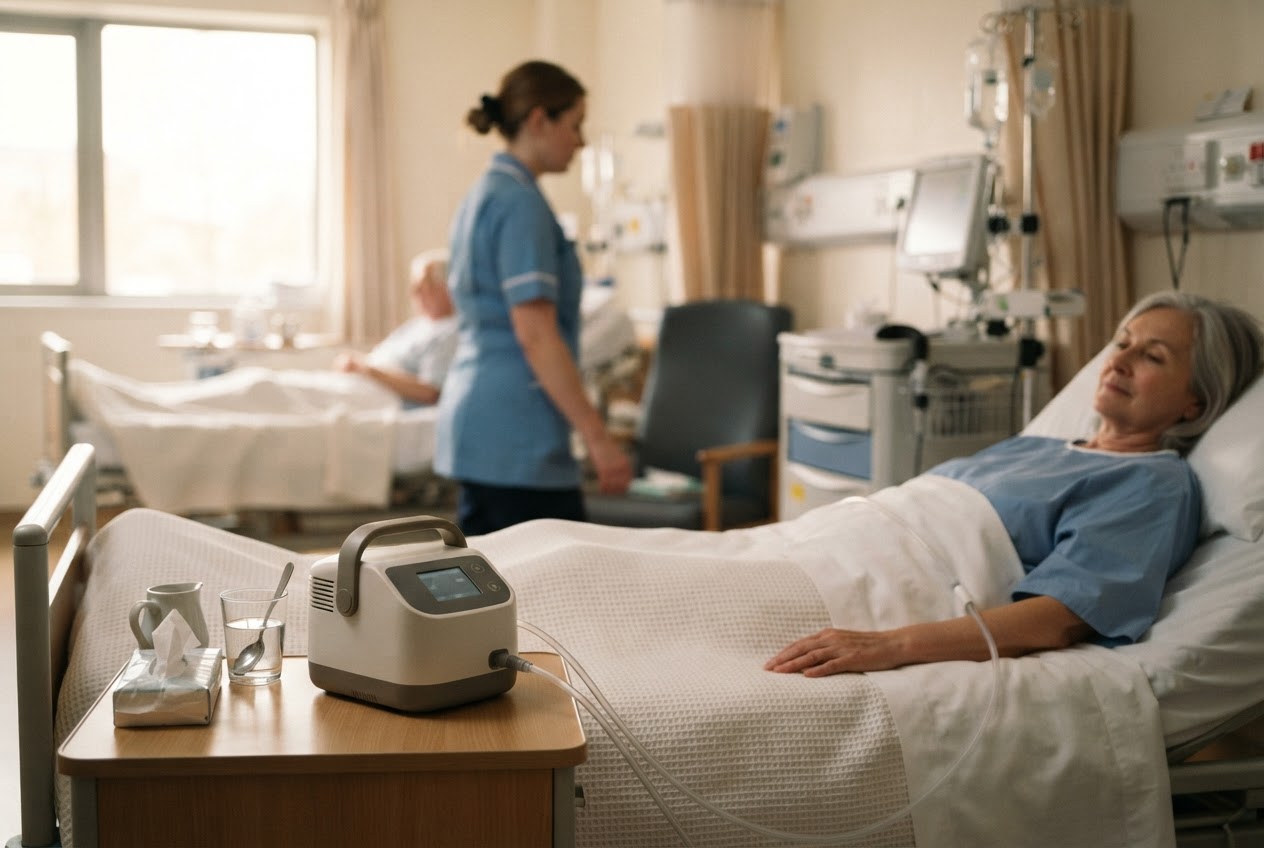
Tracheostomy Care: A Guide for Care and Nursing Teams


Tracheostomy care is the everyday care that keeps a tracheostomy tube clear, clean and secure. It covers keeping the air moist, cleaning the inner tube, clearing secretions with suction, looking after the skin around the opening, and knowing what to do if the tube blocks or comes out. Staff need hands-on training first, and must follow the person's care plan.
What is a tracheostomy?
The NHS describes a tracheostomy as a procedure where a hole is made at the front of the neck and a tube is placed into the windpipe to help someone breathe. It may be done:
- to help someone breathe if their throat is blocked
- to remove excess fluid and mucus from the lungs
- to deliver oxygen from a ventilator to the lungs
The tube is removed when the person no longer needs help breathing, which can take days or weeks. Some people need it for much longer and live with it at home, in supported living or in a care home. People who use a ventilator through their tracheostomy need staff trained in that too; see our safe use of a ventilator course.
Tracheostomy or laryngectomy?
The difference matters in an emergency. After a laryngectomy, the person cannot breathe through their nose and mouth at all, because these are no longer connected to the lungs. The National Tracheostomy Safety Project (NTSP) points out that oxygen given by face mask will not work for them. Many people with a tracheostomy still have an upper airway connected to their lungs. The person's bedhead sign and care plan should make clear which applies.
Types of tracheostomy tube
The NTSP admits the range of tubes "can be confusing". At awareness level, staff need to know two features:
- Cuffed or uncuffed. A cuff is a small balloon near the end of the tube that helps seal the airway. It reduces the chance of saliva or food going into the lungs and makes ventilation more effective. While the cuff is inflated, the person can't speak.
- With or without an inner cannula. An inner cannula is a tube inside the outer tube that can be removed and cleaned without changing the whole tracheostomy. It narrows the airway slightly, which matters for some people on ventilators.
The tube type, size and any speaking valve should be recorded in the care plan. Staff shouldn't have to guess.
Daily care principles
The NTSP puts it simply: basic care, done well, keeps people safe. Many complications are predictable and preventable.
Humidification
Normally the nose and upper airway warm and moisten the air we breathe. A tracheostomy bypasses them, so air arrives cold and dry. Secretions then become thick and sticky and can form a crust around the tube. The NTSP warns that not humidifying properly can block the tube or the stoma. The care plan will set out how humidification is given for that person.
Cleaning the inner cannula
Secretions build up inside the tube. An inner cannula lets this be cleaned or swapped without disturbing the outer tube. How often, and how, depends on the tube and the manufacturer's instructions, so follow the care plan.
Suction
People with a tracheostomy often can't cough well enough to clear their own secretions, so they need suction to keep the airway clear. Tracheostomy suction must only be done by staff trained in it, following the care plan. Clearing the mouth is a separate skill, covered in our oral suctioning training.
Stoma and skin care
The skin around the opening (also called a stoma) is cleaned and the dressing changed as the care plan sets out. Staff should look for redness, soreness or bleeding, and check the tube is secure in its tapes or ties. Blood or blood-stained secretions around the tube is one of NTSP's warning signs.
Equipment at the bedside
The NTSP stresses keeping the bed area safe and equipped. Its bedside checklist for children includes a spare tube of the same size, a spare tube half a size smaller, spare tapes and a suction catheter. Your local policy and the person's care plan set the full list for adults and children, and someone should check it every day.
Communication
Losing your voice is frightening. Speech and language therapists play a key part in the tracheostomy team. Depending on the person, they may use a speaking valve, have the cuff let down so air can pass the voice box, or use other ways to communicate. On shift:
- keep the call bell, pen and paper, or communication aid within reach
- ask yes or no questions and give the person time to answer
- agree a clear signal for "I can't breathe"
Warning signs and emergencies
The NTSP says warning signs often come before a tracheostomy emergency. Its red flags include:
- noisy breathing, whistling, grunting, snoring or stridor
- difficulty breathing, faster breathing or low oxygen levels
- air, voice or bubbles of saliva at the mouth or nose when the cuff should be sealing
- a tube that looks displaced
- blood or blood-stained secretions around the tube
- new discomfort or pain
- a cuff that needs a lot of air to stay inflated
- changes in pulse, blood pressure or level of consciousness, or new anxiety, restlessness, agitation or confusion
The two emergencies everyone fears are a blocked tube and a displaced tube. The NTSP publishes emergency algorithms for both tracheostomy and laryngectomy, built to deal with the common, fixable problems first and then escalate. Its first responder guidance says that whatever your background, a few key steps make a real difference: call for help, assess the airways and apply oxygen. Trained staff then take simple actions such as removing a speaking valve or inner tube and passing a suction catheter.
Resuscitating someone with a tracheostomy or laryngectomy is different from standard CPR, so staff need specific training on top of basic life support.
Bedhead information
NTSP produces bedhead signs, paired with its algorithms, that set out critical information about the person's airway. There are versions for tracheostomy and laryngectomy, and they can be adapted for local use. Ask the discharging hospital or specialist team to complete one, and make sure every member of staff, including agency and night staff, knows what it means.
Who does what
A specialist team, often including doctors, nurses, physiotherapists and speech and language therapists, plans the person's tracheostomy care. In a care service, nurses, healthcare assistants and carers carry out daily care after training and your own supervised sign-off, always following your local policy and the person's care plan.
How Kasorb can help
Our tracheostomy care training teaches nurses, healthcare assistants and carers to look after someone with a tracheostomy safely. It covers the anatomy of the trachea, types of tracheostomy tube, communicating to reduce distress, tracheostomy risk assessment, changing dressings, suctioning and removing the tube, humidification, managing emergencies such as a blocked or displaced tube, and tracheostomy resuscitation.
It runs as a half day (three hours) for up to 10 staff, at one price for the group, quoted for your location. First-time staff train on-site with hands-on practice on a tracheostomy training model; live online sessions suit refreshers. The session is tailored to the people you support, and we'll do our best to work to a discharge date. Your trainer has used these skills for real. Certificates are emailed the next day, and we recommend an annual refresher.
FAQs
What does tracheostomy care involve?
Keeping the tube clear, clean and secure. That means humidifying the air, cleaning or changing the inner cannula, suctioning secretions, cleaning the skin around the opening and changing dressings, checking emergency equipment, and knowing how to respond if the tube blocks or comes out. Follow the person's care plan.
Can carers do tracheostomy care?
Yes, in many services healthcare assistants and carers carry out daily tracheostomy care once they have been trained and signed off by their employer. They work within the person's care plan and local policy, with support from the specialist team that planned the person's care.
Can someone with a tracheostomy talk?
Often, yes. The NHS explains that a person can't speak while the tube's cuff is inflated, but as they recover the cuff can be let down and a speaking valve may be fitted. Speech and language therapists advise on the best approach for each person.
What is the difference between a tracheostomy and a laryngectomy?
After a laryngectomy the nose and mouth are no longer connected to the lungs, so the person breathes only through the opening in their neck and face-mask oxygen won't work. Many people with a tracheostomy still have an upper airway. The bedhead sign should show which applies.
Why is humidification important with a tracheostomy?
The tube bypasses the nose and upper airway, which normally warm and moisten the air. Without humidification, secretions become thick and sticky and can crust around the tube. The National Tracheostomy Safety Project warns this can block the tube or stoma.
On-site training for your whole team at one flat rate. See what's covered, prices and how to book.
See the course

Not sure which course your team needs? Tell us about your setting and we'll confirm within 48 hours.