Blood Bottle Colours and Order of Draw: A UK Guide
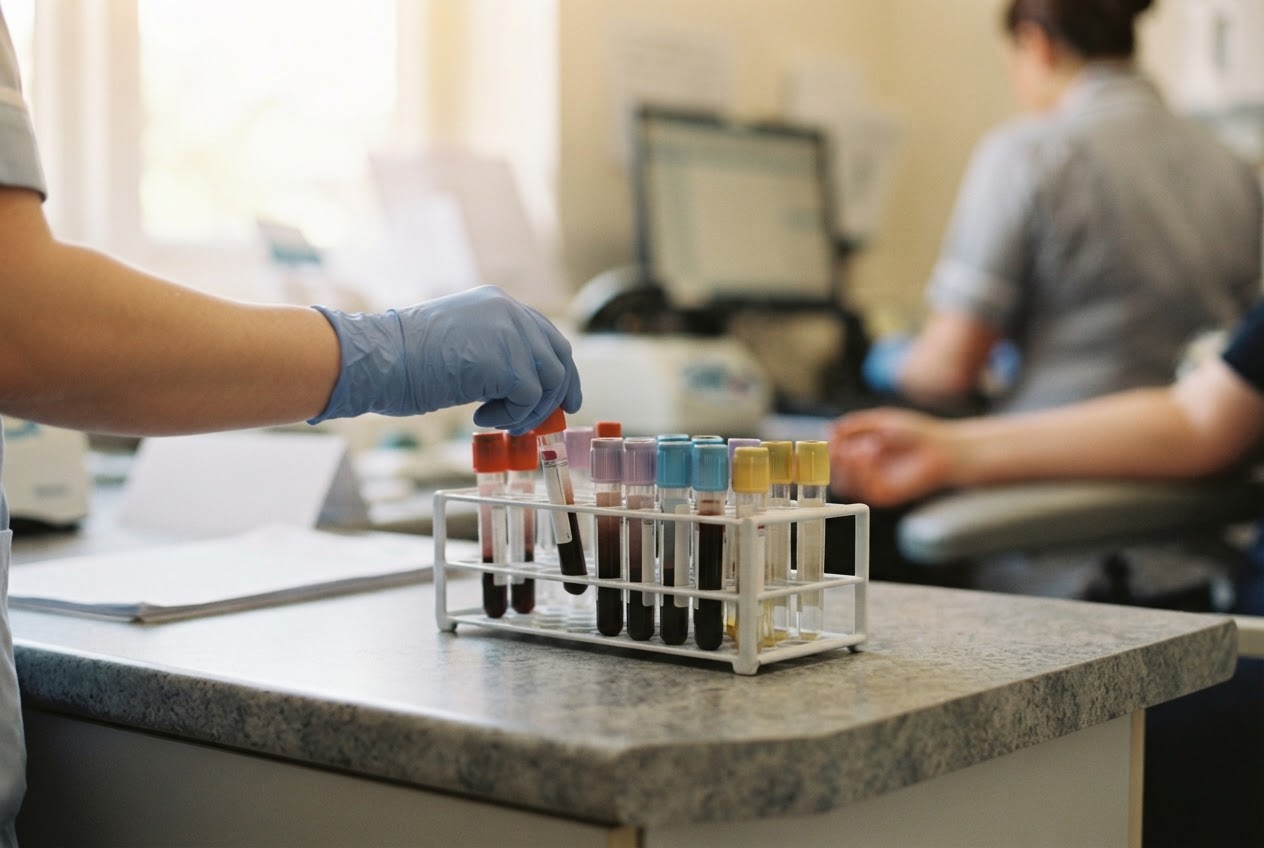

Blood bottle colours tell you which additive is in the tube, and so which tests it can be used for. On the BD system many UK labs use, blue is citrate for clotting tests, gold is serum for most chemistry, lavender is EDTA for a full blood count and grey is fluoride oxalate for glucose. Colours differ between manufacturers, so always follow your own lab's guide.
This guide is for nurses, care practitioners and senior carers who take blood, and the managers who support them.
Why the colour matters
Every plastic blood tube contains something, even the "plain" serum ones. Some hold an anticoagulant to stop the blood clotting, some a clot activator, some a gel that separates serum from cells once the sample is spun. The lab can only run a test on the right kind of sample, so the wrong tube can mean the test can't be done and the person has to be bled again.
Common blood bottle colours in the UK
These are the colours on the BD Vacutainer system, as set out in NHS lab guides such as those from Gloucestershire Hospitals, North Bristol and Maidstone and Tunbridge Wells. Typical tests vary between labs, so treat these as examples:
- Blue (sodium citrate): clotting tests such as INR, APTT and D-dimer. It must be filled to the line.
- Red (plain serum, no gel): tests your lab says can't be done on a gel tube.
- Gold (serum with gel, often called SST): most routine chemistry, such as kidney, liver and thyroid function, CRP and lipids, plus many antibody tests.
- Green (lithium heparin): plasma tests, which vary a lot from lab to lab.
- Lavender or purple (EDTA): full blood count and HbA1c, among others.
- Pink (EDTA for transfusion): group and save, and crossmatch.
- Grey (fluoride oxalate): glucose, lactate and blood alcohol.
- Dark blue (trace elements): zinc, copper and selenium, for example.
Not every lab uses the same colours
Labs in the UK use tubes from more than one manufacturer, and the caps don't always match. Manchester University NHS Foundation Trust's tube guide is a good example: citrate is green, lithium heparin is orange, fluoride is yellow, serum gel is brown, routine EDTA is pink and transfusion EDTA is blue.
So "the blue one" can mean a clotting tube in one hospital and a transfusion tube in the next. If staff move between services, or your lab changes supplier, check the tube guide first. The WHO's guidelines on drawing blood make the same point: check the order and the tubes with your local lab, because colour coding and additives vary.
The order of draw
When you fill several tubes from one needle, the order matters. Most UK lab guides follow the international order set by the Clinical and Laboratory Standards Institute (CLSI). On the BD system, that looks like this:
- Blood cultures, if they're needed.
- Blue: sodium citrate.
- Red, then gold: serum tubes, without and with gel.
- Green: lithium heparin.
- Lavender, then pink: EDTA.
- Grey: fluoride oxalate.
Where special tubes, such as trace elements, go in the order differs between labs, so check your own chart. If your lab uses another manufacturer, follow the order on its chart, not the colours above.
Why the order of draw matters
The WHO guidelines give the reason plainly: tubes are drawn in order to avoid cross-contamination of additives between tubes. A trace of one tube's additive carried into the next can distort that sample's results, and a distorted result can lead to the wrong treatment decision or a repeat test.
The citrate tube needs extra care. Its results depend on the right ratio of blood to anticoagulant, so it must be filled to the line, and labs such as Gloucestershire Hospitals won't process under-filled ones. Greiner Bio-One's order of draw guidance notes that with a winged collection set the first tube will be under-filled, so it recommends a discard tube before a citrate tube drawn first.
Labelling and patient identification
Good technique is wasted if the label is wrong. The WHO guidelines say to ask the person to state their full name and check it against the request form. Where someone can't tell you their name, follow your policy for confirming who they are.
Labs set their own minimum details. Gloucestershire Hospitals' labelling policy, for example, asks for surname, first name, and NHS number or date of birth with address, plus the date and time of collection and the sample taker's signature on transfusion samples. It also says:
- tubes must be labelled while you are with the person, never before
- transfusion sample labels must be handwritten, not printed
- samples that don't meet the policy are rejected, and transfusion samples are never treated as unrepeatable
Your lab's rules may differ, so keep a copy with the equipment.
Common sample errors, and how to avoid them
- Wrong tube or wrong order. Check the request and the lab's chart first, and line the tubes up before you start.
- Under-filled citrate tube. Fill to the line.
- Poor mixing. Gently invert each tube straight after filling, the number of times your lab's guide states. Don't shake it. BD's guides warn that poor mixing can give inaccurate results and mean a repeat.
- Haemolysis. The WHO guidelines link it to forcing blood through a syringe and to the wrong needle gauge. They also advise taking the tourniquet off before it has been on for two minutes.
- Pouring blood between tubes. If you make a mistake, don't transfer blood from one tube to another.
- Out-of-date tubes. Check expiry dates; labs such as Maidstone and Tunbridge Wells refuse expired bottles.
- Delay. Most samples deteriorate over time, and some tests, such as lactate, have tight time limits.
Getting samples to the lab
The WHO guidelines advise packing samples in a sealed, leak-proof bag with the request form in a separate outer pocket, and using a rack or padded holder for several tubes. Gloucestershire Hospitals adds a few practical rules: check caps are secure, never send a sample with a needle attached, and bag transfusion and microbiology samples separately. In a care home or the community, know your collection times and ask the lab how samples should be stored if there's a delay.
Keep infection prevention and control in mind throughout: sharps go straight into the sharps bin, and spills are cleaned up under your policy.
How Kasorb can help
Kasorb's venepuncture training teaches nurses, care practitioners and senior carers to take blood safely. It covers roles and responsibilities, common blood tests and why they're requested, the anatomy of the arm's veins, choosing a site, safe tourniquet use, preparing the person and the equipment, aseptic technique, complications and what to do if someone becomes unwell, and accurate labelling and documentation. Each person practises three times on a prosthetic vascular arm, using the same needles you use in practice, with feedback from the trainer.
It runs on site anywhere in the UK as a full day for up to 10 staff, at one flat rate for the group, with a refresher that can run live online. Your trainer has used these skills for real. Certificates are emailed the next day, and your own supervised sign-off in practice completes the process.
FAQs
What colour blood bottle is used for a full blood count?
On the BD system used by many UK labs, a full blood count goes in a lavender (purple) EDTA tube. Labs using other manufacturers' tubes may use a different cap for EDTA, such as pink. Check your own lab's tube guide before you take the sample.
What is the correct order of draw for blood bottles?
Most UK lab guides follow the CLSI order. On the BD system that's blood cultures first, then blue citrate, red and gold serum tubes, green lithium heparin, lavender and pink EDTA, and grey fluoride oxalate. Special tubes such as trace elements vary, so always follow your own lab's chart.
Why does the order of draw matter?
Each tube contains an additive. Drawing in the wrong order risks carrying a trace of one tube's additive into the next, which can distort results. The WHO's guidelines on drawing blood recommend drawing tubes in the correct order for this reason, and checking that order with your local lab.
What colour tube is used for blood glucose?
On the BD system, glucose goes in a grey fluoride oxalate tube, which contains an additive that stops the blood cells using up the glucose before testing. On other systems the cap may be a different colour, such as yellow. Check your lab's guide and send the sample promptly.
Why do labs reject blood samples?
Common reasons include missing or mismatched patient details, the wrong tube, an under-filled clotting tube, out-of-date tubes and delays reaching the lab. Transfusion samples are checked especially strictly. Poorly mixed or haemolysed samples can also give inaccurate results, which means the person has to be bled again.
On-site training for your whole team at one flat rate. See what's covered, prices and how to book.
See the course

Not sure which course your team needs? Tell us about your setting and we'll confirm within 48 hours.