DVT Symptoms and PE Signs: A Guide for Care Teams
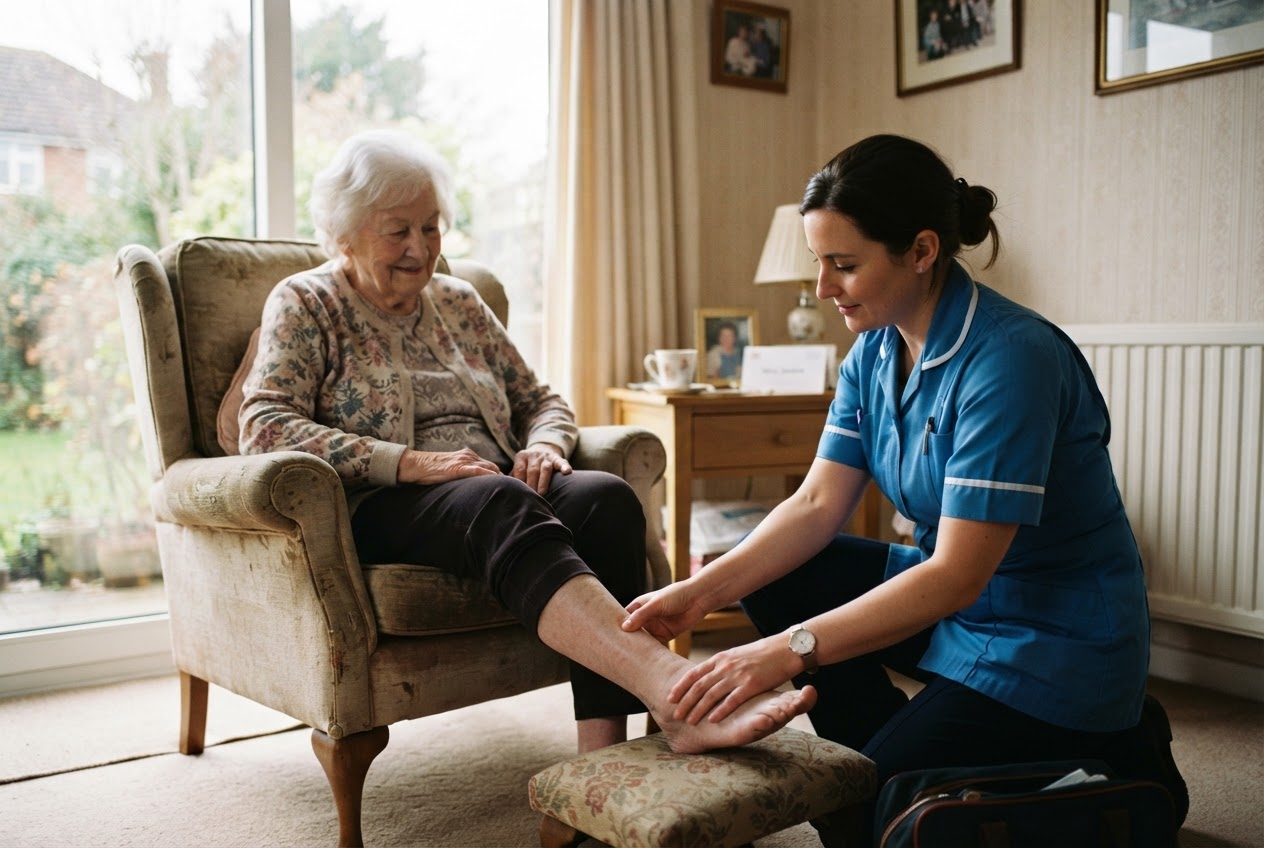

The main DVT symptoms are throbbing pain and swelling in one leg, usually the calf or thigh, with red, blue or darkened skin around the painful area and swollen veins. If someone has these signs and is also short of breath or has chest pain, call 999: the clot may have travelled to the lungs, which is a pulmonary embolism.
This is awareness-level information for care and support teams. Follow your local policy and the person's care plan.
DVT, PE and VTE: what the terms mean
- Deep vein thrombosis (DVT) is a blood clot in a deep vein, usually in the leg.
- Pulmonary embolism (PE) is a blood clot blocking a blood vessel in the lungs. The NHS explains that it often happens when part of a clot in the leg breaks off and travels there.
- Venous thromboembolism (VTE) is the umbrella term for both.
A PE can be life-threatening and needs treatment straight away, which is why spotting a DVT early matters.
DVT symptoms
The NHS lists these symptoms of DVT in the leg:
- throbbing pain in one leg (rarely both), usually in the calf or thigh
- swelling in one leg (rarely both)
- red, blue or darkened skin around the painful area, which may be harder to see on brown or black skin
- swollen veins
The same symptoms can appear in an arm if that's where the clot is. Rarely, the only sign is pain in the lower tummy, which can mean a clot in a pelvic vein.
When the person can't tell you
Many people in care can't describe pain clearly, including people living with dementia, a learning disability or communication differences. On shift, the clues are often behavioural: someone who suddenly won't stand or walk, guards or rubs one leg, flinches during personal care or a transfer, or has one leg that looks bigger than the other at bedtime. Compare both legs, note what you see and report it. You don't need to be sure it's a clot to raise it.
Pulmonary embolism symptoms
The NHS lists these symptoms of PE:
- difficulty breathing that comes on suddenly
- chest pain that's worse when breathing in
- coughing up blood
- pain, redness and swelling in one leg, usually the calf, which may be the DVT that caused it
Difficulty breathing can also be a sign of other emergencies, such as sepsis. Staff don't need to work out which. Their job is to recognise that the person is unwell and escalate quickly.
When to call 999 and when to call 111
Call 999 or go to A&E if the person:
- has DVT symptoms and is short of breath or has chest pain
- has severe difficulty breathing
- has pain in the chest or upper back
- has a very fast heartbeat
- has passed out
The NHS says not to drive the person to A&E yourself; call an ambulance or have someone else drive. Send their medicines, or a current list, with them.
Get an urgent GP appointment or call 111 if:
- you think the person has a DVT
- they have sudden difficulty breathing that isn't severe, or are coughing up blood
In a care service, your escalation policy may name a GP, community nurse or clinical lead to call first for a suspected DVT. If in doubt, or if any of the 999 signs above appear, call 999.
Who is at risk
The NHS describes risk factors that people live with long term, and others that are temporary.
Longer-term risks include: being over 60, being overweight, smoking, a previous DVT, cancer, heart failure, varicose veins, a condition that makes blood clot more easily, inflammatory bowel disease, and taking HRT or contraception containing oestrogen.
Temporary risks include: a recent hospital stay, especially with limited movement; surgery; bed rest for three days or more; journeys of more than four hours; pregnancy and the six weeks after giving birth; and being dehydrated.
In care, that picture is familiar: someone home after an operation, a resident who has stopped walking after a fall, or a person spending most of the day in bed. Keeping people moving safely is where falls prevention and VTE prevention overlap.
VTE risk assessment: what NICE NG89 says
In England, NICE guideline NG89 (published 2018, updated 2019) covers reducing the risk of VTE in people aged 16 and over in hospital. It also covers people discharged with a plaster cast or similar on the leg.
In brief, it says hospitals should:
- assess all medical, surgical and trauma patients for their risk of VTE and of bleeding, as soon as possible after admission or by the first consultant review
- use a recognised tool; NICE notes that the Department of Health VTE risk assessment tool is commonly used for medical patients
- reassess at consultant review or whenever the person's condition changes
- give people, and their family or carers, verbal and written information on discharge about the signs of DVT and PE and the importance of getting help
Formal VTE risk assessment is a clinical job, usually done in hospital. For care teams, the useful part comes after: check the discharge letter for preventive medicine or anti-embolism stockings, and for how long. The NHS notes that preventive treatment sometimes continues after someone leaves hospital.
Prevention at awareness level
Most of what care staff can do is everyday good care:
- Keep people moving. NICE says to encourage people to mobilise as soon as possible, and the NHS advises getting up and moving about roughly every hour. For people who can't walk, follow the care plan for position changes and any exercises a physiotherapist has set.
- Keep people hydrated. NICE says not to let people become dehydrated unless there's a clinical reason. Offer drinks regularly and record intake where the care plan asks for it.
- Stockings, if prescribed. NICE says anti-embolism stockings should be measured and fitted by staff trained in their use, and removed daily for hygiene and a skin check. Report skin marking, blistering or discolouration, or stockings that aren't being worn correctly.
- Anticoagulant medicines, if prescribed. Give them as prescribed under your medication policy, report missed doses, and report any unusual bleeding or bruising.
What to record and report
When you report a possible clot, be specific: which limb, what you saw, when it started, whether it's getting worse, and whether the person is breathless or has chest pain. Record what you did and who you told. If your service uses NEWS2 or RESTORE2, include the score.
How Kasorb can help
Kasorb's VTE awareness training teaches care and support staff to recognise the signs of DVT and pulmonary embolism, understand who is at risk, and support prevention through mobility, hydration and positioning. It covers what VTE, DVT and PE are, signs and symptoms, when to call 999, awareness of anti-embolism stockings and anticoagulant medicines, and recording and reporting. It's awareness training: it doesn't cover VTE risk assessment, prescribing or fitting stockings.
Your trainer has used these skills for real. Training runs at your premises anywhere in the UK or live online, for up to 12 staff at one flat rate for the group, and certificates are emailed the next day.
FAQs
What are the first signs of a blood clot in the leg?
According to the NHS, the main signs of a DVT are throbbing pain in one leg, usually the calf or thigh, swelling in that leg, red, blue or darkened skin around the painful area and swollen veins. Discoloured skin may be harder to see on brown or black skin.
Should I call 999 or 111 for a suspected DVT?
The NHS advises an urgent GP appointment or a call to 111 for a suspected DVT. Call 999 if the person also has chest pain or is short of breath, or has severe breathing difficulty, a very fast heartbeat or has passed out, as the clot may have reached the lungs.
What is a VTE risk assessment?
It's a check, usually done in hospital, of a person's risk of developing a blood clot and their risk of bleeding. NICE guideline NG89 says it should happen as soon as possible after admission, using a recognised tool, and be repeated if the person's condition changes. It guides decisions about preventive treatment.
Who is most at risk of DVT?
The NHS lists people over 60, people who are overweight or smoke, and those with a previous DVT, cancer or heart failure. Temporary risks include a recent hospital stay, surgery, three or more days of bed rest, pregnancy and the six weeks after birth, and dehydration.
What is the difference between DVT and PE?
A DVT is a blood clot in a deep vein, usually in the leg. A pulmonary embolism (PE) is a clot blocking a blood vessel in the lungs, often because part of a leg clot has broken off and travelled there. Together they're called venous thromboembolism (VTE).
On-site training for your whole team at one flat rate. See what's covered, prices and how to book.
See the course

Not sure which course your team needs? Tell us about your setting and we'll confirm within 48 hours.