Personal Emergency Evacuation Plan (PEEP): A UK Guide

A personal emergency evacuation plan (PEEP) is a written plan for one person who may not be able to get out of a building quickly or without help in an emergency. It sets out how they'll be alerted, the route they'll take, who will help them and what equipment they'll need. In workplaces and care settings, arranging it falls to whoever is responsible for fire safety.
Who needs a PEEP
Anyone whose ability to leave the building unaided is affected by a physical or cognitive impairment or condition. That might be a permanent disability, a temporary injury, or a change in health. In practice, think about people who:
- use a wheelchair or walking aid, or can't manage stairs
- may not hear the alarm or see the signs
- may not understand what's happening, for example someone living with dementia
- are drowsy at night because of their medication or condition
- need help to get out of bed or into a chair
Government guidance on means of escape for disabled people describes two kinds of plan. Staff and regular visitors who need one get an individual plan, tailored to them. Visitors and occasional users are offered a standard plan, kept at reception, setting out the options. Visitors can decline, but should always be offered one.
What the law says
England and Wales
The Regulatory Reform (Fire Safety) Order 2005 puts duties on the "responsible person": usually the employer, or whoever controls the premises. Under Article 15, they must set up emergency procedures, including drills, and appoint enough people with the training, experience and knowledge to carry out an evacuation. Article 21 requires staff to be trained in the fire precautions and actions they need to take, when they start, when risks change, and repeated as needed.
If someone in your building can't evacuate unaided, your fire risk assessment and procedures have to show how they will get out. A PEEP is how you show it for each person.
The government guidance is clear on one point: an evacuation plan should not rely on the fire and rescue service to make it work, and people should never be left in a refuge waiting for firefighters. Your plan has to get people to a place of safety using your own staff and equipment.
Scotland and Northern Ireland
Scotland has its own regime under the Fire (Scotland) Act 2005. The Scottish Government's practical guidance for existing care homes says residents' personal evacuation needs should be considered and reviewed as their abilities change. In Northern Ireland, the Fire Safety Regulations (Northern Ireland) 2010 set out similar duties, including emergency procedures and staff training.
The new residential PEEP rules in England
The Fire Safety (Residential Evacuation Plans) (England) Regulations 2025 came into force on 6 April 2026. They apply in England only, and only to residential buildings with two or more homes that are:
- at least 18 metres high, or at least seven storeys, or
- more than 11 metres high with a simultaneous evacuation strategy, where everyone is told to leave in a fire rather than stay put.
For residents whose ability to evacuate is affected by an impairment or condition, the building's responsible person must:
- use reasonable efforts to identify them
- offer a person-centred fire risk assessment, and carry it out if the resident wants one
- put reasonable and proportionate measures in place after discussing them with the resident
- try to agree an emergency evacuation statement, record it, and give the resident a copy
- review it within 12 months, and sooner if things change or the resident asks
- with the resident's explicit consent, share basic details with the fire and rescue service, such as flat and floor number and the level of help needed
- also prepare a whole-building emergency evacuation plan, review it every 12 months and share it with the fire and rescue service
Taking part is voluntary. The government's residential PEEPs factsheet also explains that, unlike workplace PEEPs, the process doesn't require staff-assisted evacuation.
These rules are about blocks of flats. Care homes are non-domestic premises covered by the Fire Safety Order and its own guidance, so they don't change how you plan evacuation in a care home. If you support people living in flats in a building that meets the height test, the building's responsible person holds these duties. Your team can help the person take part, and their support plan should match whatever is agreed.
What a good PEEP contains
A PEEP should be short enough to use at 3am. As a minimum, cover:
- The person: name, room or flat, and what affects their evacuation.
- How they'll know: how they're alerted if they can't hear the alarm or won't recognise it.
- The route: primary and alternative routes, and any refuge point on the way.
- Who helps: roles, not just names. "Two staff from the first-floor team" works on every shift; "Sarah" doesn't work on Sarah's day off.
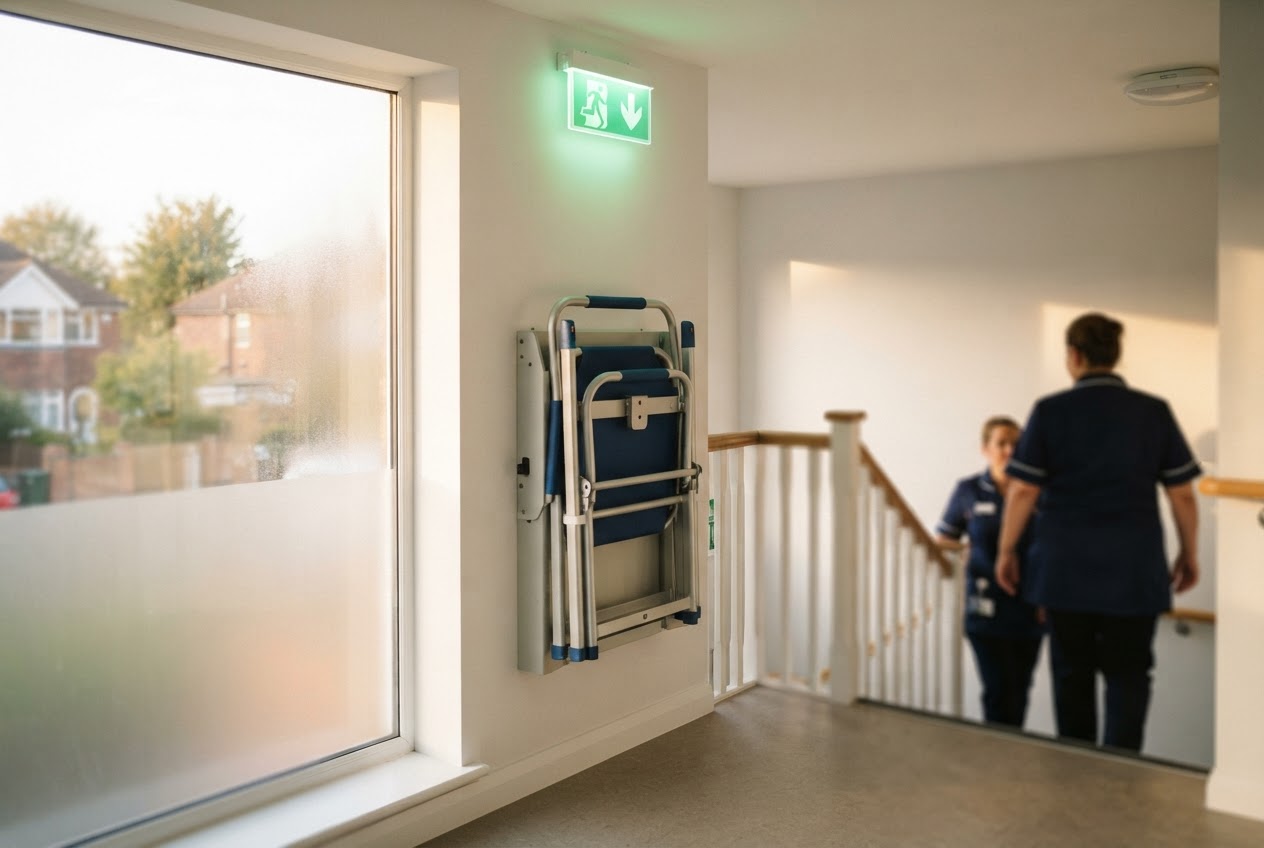
- Equipment: evacuation chair, sheet or mat, and where it's kept.
- Communication: how best to reassure and instruct the person, including any communication aids.
- Practice and review: when the plan was last practised and when it's next reviewed.
In care settings, link each PEEP to the person's care plan, so a fall or hospital stay triggers a review, and make sure agency staff know where PEEPs are kept.
Evacuation chairs and staff training
A PEEP that says "evacuation chair" is only as good as the person who has to use it. The government guidance says an evacuation chair is operated by one or two people and needs training and practice to use, and that regular staff training is essential. It also warns that chairs aren't an automatic answer for every wheelchair user, and that providing them should come with a full system of escape.
Common gaps:
- the chair is still in its wrapping, or nobody knows when it was last serviced
- only day staff have practised, but the plan relies on night staff
- the PEEP names one person who has since left
- the plan assumes the fire service will carry people out
Staff using evacuation equipment also need sound moving and handling skills, because transfers put both the person and the helper at risk. See our moving and positioning people training. Staff who lead evacuations on each floor and shift benefit from fire marshal training, and everyone else needs the basics from fire safety awareness training.
How Kasorb can help
Our evacuation chair training teaches staff to move someone with limited mobility down the stairs safely in an emergency, using the chair you actually have. It runs on-site for three hours, on your chair and your stairs, for groups of three to eight so everyone gets proper practice.
Staff cover a refresher on safe moving and handling, your site's evacuation procedure where available, when to use the chair, preparing it, transfers, moving across floors and down or up stairs, and cleaning, care and storage. Everyone is assessed practically. Training on other equipment, such as AlbacMats and evacuation sheets, is available as a separate session.
Your trainer has used these skills for real. Staff need moving and handling training first, and your chair's maintenance should be up to date before the day. It's one flat rate for the group, and certificates are valid for 12 months and emailed the next day.
This guide summarises the law and guidance; it isn't legal advice.
FAQs
What is a PEEP in fire safety?
A personal emergency evacuation plan is a written plan for someone who may not be able to leave a building quickly or unaided in an emergency. It records how they'll be alerted, their escape route, who will help them, and any equipment needed, such as an evacuation chair.
Is a PEEP a legal requirement?
In England and Wales, the Fire Safety Order requires emergency procedures that get everyone out safely, including people who need help. A PEEP is how you show that for each person. Separate residential PEEP rules for some blocks of flats in England began on 6 April 2026.
Who is responsible for writing a PEEP?
The responsible person for fire safety, usually the employer or whoever controls the premises. They can ask a trained member of staff to draw it up, but the duty stays with them. Write it with the person it's for, so it reflects what they can and can't do.
How often should a PEEP be reviewed?
Whenever the person's needs, the building or your staffing change, and at a regular interval set in your fire procedures. Under the new residential rules in England, evacuation statements must be reviewed within 12 months. In care settings, link reviews to care plan reviews, falls and hospital discharges.
Do staff need training to use an evacuation chair?
Yes. Government guidance says evacuation chairs need training and practice, and that regular staff training is essential. Staff named in a PEEP should practise on the chair and stairs in your building, and on every shift pattern the plan relies on.
On-site training for your whole team at one flat rate. See what's covered, prices and how to book.
See the course

Not sure which course your team needs? Tell us about your setting and we'll confirm within 48 hours.