CQC Dental Training Gap Index 2026: What Inspectors Found About Staff Training in Dental Practices


We read what CQC inspectors wrote about staff training in the latest reports for 2,080 dental practices in England. At 1 in 6 (350), inspectors found a staff training gap. The most common wasn't clinical. It was fire safety.
Key findings
- Inspectors found a staff training gap at 16.8% of dental practices (350 of 2,080), about 1 in 6.
- Including practices where inspectors said the systems for tracking training weren't working, the figure is 19.8% (412), about 1 in 5.
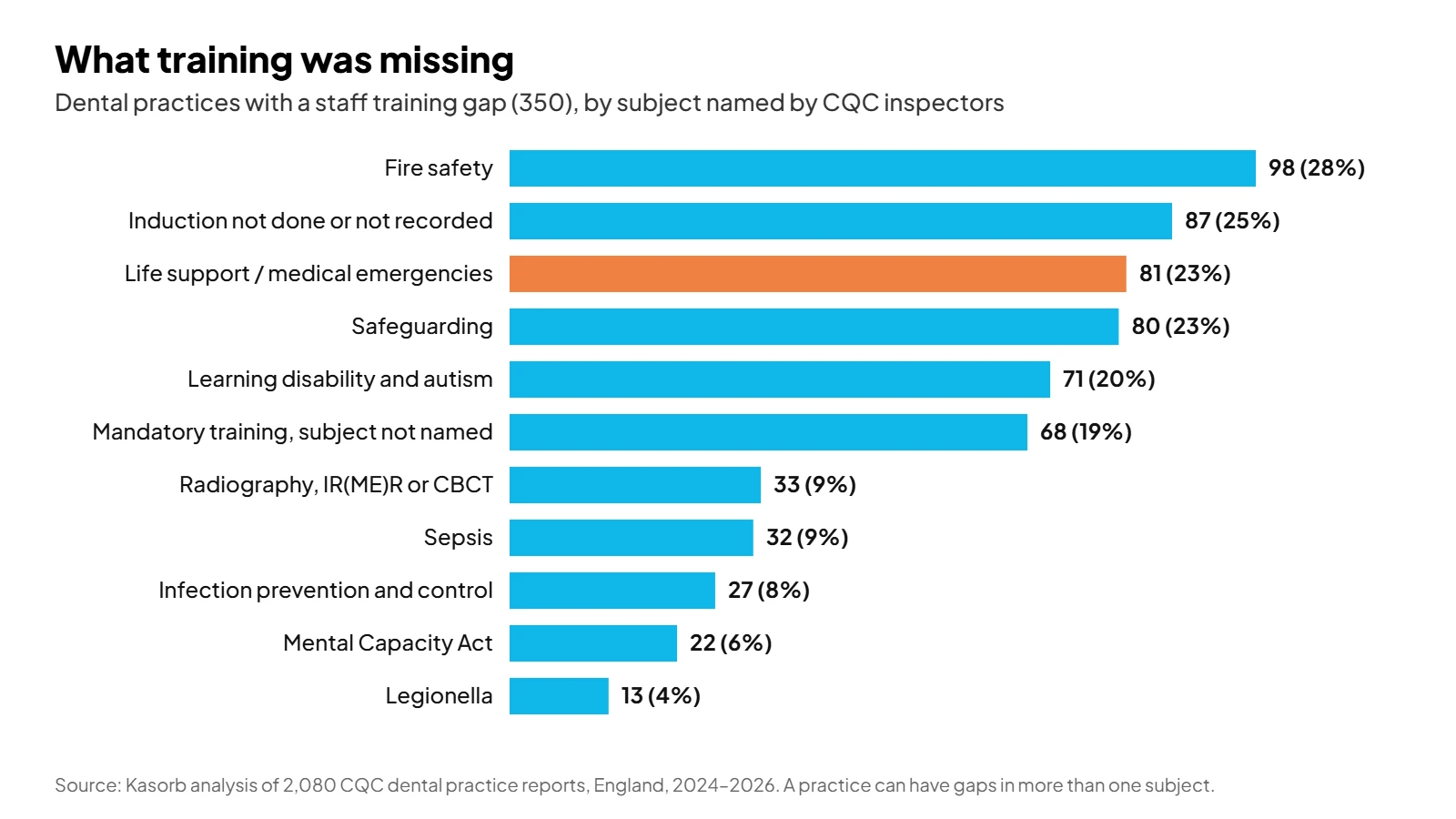
- Fire safety was the most common gap, at 98 practices. Then induction not done or not recorded (87), life support and medical emergencies (81), safeguarding (80) and learning disability and autism (71).
- 1 in 26 practices (81) had a gap in life support training. In about a third of these, it involved staff treating patients under sedation who couldn't show up-to-date immediate life support (ILS) training.
- Of the 86 practices that didn't meet every regulation, 59% had a staff training gap (51). Among practices that met every regulation, it was 15% (299 of 1,994).
- 64 practices had gaps in three or more subjects at once.
What training was missing
Fire safety came first: 28% of practices with a gap, often a few staff overdue on their annual fire awareness training. Induction came next (25%): new or agency staff with no structured induction, or no record of one. Life support and safeguarding were each named at 23%, and learning disability and autism training at 20%.
Example wording from CQC reports (no practice named):
- "We noted 5 members of clinical staff had not completed fire safety training."
- "We did not see documentation to demonstrate that newly appointed staff received a structured, role-specific induction."
- "There was no evidence to confirm that staff providing treatment to patients under sedation had completed immediate life support training."
Life support and medical emergencies
CQC checks that every member of the dental team has done medical emergency and basic life support training in the last year. At 81 practices, inspectors found that some hadn't, or that the practice couldn't show it. The patterns:
- Sedation teams without ILS. About a third of the life support gaps involved staff treating patients under sedation, who need immediate life support training, not just basic life support.
- Online only. At 11 practices, inspectors flagged that life support training had been done online, with no hands-on practice.
- One or two people overdue. Often a single member of staff whose annual refresher had lapsed, or a new starter who hadn't done it yet.
Many were fixed within days of the inspection. Until then, if a patient had collapsed in the chair, not every member of staff could show they were trained to help. More on medical emergency training for dental teams and dental ILS.
Practices that met every regulation
Meeting every regulation doesn't mean inspectors found nothing. Among the 1,994 practices that met every regulation, inspectors still noted a staff training gap at 299 (15%), about 1 in 7. These were usually small and fixed quickly, but they were written into the report.
By region
Share of dental practices with a staff training gap recorded by inspectors:
- South West: 29% of 128 practices
- London: 21% of 353
- North West: 20% of 307
- South East: 19% of 231
- Yorkshire and the Humber: 19% of 161
- East of England: 14% of 263
- West Midlands: 13% of 365
- North East: 11% of 122
- East Midlands: 5% of 148
Some of the difference between regions may come from how different inspection teams write their reports, so treat these as a guide rather than a ranking. Confidence intervals are in the download below.
What practice managers can do
Built from what inspectors wrote, not from Kasorb's courses:
- Training matrix up to date, with completion and expiry dates for every member of staff, including associates, locums, hygienists and visiting clinicians.
- Certificates on file and easy to find on the day. Evidence sent after the inspection still gets written up.
- Medical emergency and basic life support training for the whole team every year, with hands-on practice, not online only.
- Immediate life support training in date for everyone involved in treatment under sedation.
- A structured induction for every new starter, signed off and kept on file.
- Fire awareness, safeguarding (at the right level for each role), and learning disability and autism training, required since July 2022.
- Someone named to check the matrix regularly, so gaps are found before the inspector finds them.
How we did it
- Took every dental location in CQC's ratings data (October 2026) with a report under CQC's current assessment approach: 2,093 locations. 13 had no report we could read, leaving 2,080 practices.
- Read the overall, Safe, Effective and Well-led pages of each practice's latest report on cqc.org.uk, and pulled every sentence mentioning training, induction, CPD, life support, resuscitation, sepsis, learning disability or autism.
- Coded each practice: a staff training gap found by inspectors (training missing, out of date, overdue or not evidenced, or induction not done or not recorded); weak oversight of training (systems for tracking training not working); and whether the gap involved life support. Gaps fixed after inspectors raised them count. Gaps fixed before the assessment, suggestions and CQC's standard positive wording don't.
- Every practice was coded twice, by two coders working independently against the same written guide. They agreed on 99.3% of practices for a training gap (kappa 0.98), 99.2% for weak oversight (kappa 0.95) and 99.7% for life support (kappa 0.96). The 31 disagreements were settled by a third reviewer, with a reason recorded for each.
Limits. CQC doesn't inspect every practice each year. It prioritises practices never inspected, those not inspected for a long time, and those where there's a concern, so these figures describe inspected practices, not all dental practices. Reports cover what inspectors chose to write about, so no training finding doesn't prove training was complete. A training gap doesn't mean a practice is unsafe. England only.
Data and credits
- Download the data (CSV): figures by measure, subject and region, with confidence intervals. No practice is named.
- Cite as: Kasorb (2026), CQC Dental Training Gap Index 2026, kasorb.com/blog/cqc-dental-training-gap-index. Reports read 23–24 October 2026.
- Contains CQC data and report text, © Care Quality Commission, used under the Open Government Licence v3.0.
- Author: Steve van de Worp, founder, Kasorb.
- See also: CQC Training Gap Index 2026 for care homes.
FAQs
What is the most common staff training gap CQC finds in dental practices?
Fire safety training: named at 98 of the 350 practices with a gap (28%), often a few staff overdue on their annual fire awareness training.
How many dental practices have gaps in life support training?
81 of 2,080 inspected practices (3.9%), about 1 in 26. About a third involved staff treating patients under sedation without up-to-date immediate life support training.
Do practices that meet every regulation have training gaps?
Some do. Inspectors noted a staff training gap at 15% of practices that met every regulation (299 of 1,994).
Does a training gap mean a dental practice is unsafe?
No. It means inspectors recorded a shortfall in staff training, induction or training records at that assessment. Many were fixed soon after.
Will this be updated?
Yes, every year, at the same address.
On-site training for your whole team at one flat rate. See what's covered, prices and how to book.
See the course

Not sure which course your team needs? Tell us about your setting and we'll confirm within 48 hours.