Fire Safety Training Enforcement Index 2026

When a fire and rescue service finds that a business or other premises isn't meeting fire safety law, it can serve an enforcement notice setting out what must be put right. We looked at every enforcement notice on the public registers for England and Wales over three years: 4,506 notices from 46 fire and rescue services. In 3 in 10, the fire service cited a failure to give staff adequate fire safety training. At shops, pubs, bars and restaurants it was about half.
Key findings
- 30% of fire safety enforcement notices cited staff fire safety training (1,370 of 4,506), under Article 21 of the Regulatory Reform (Fire Safety) Order 2005.
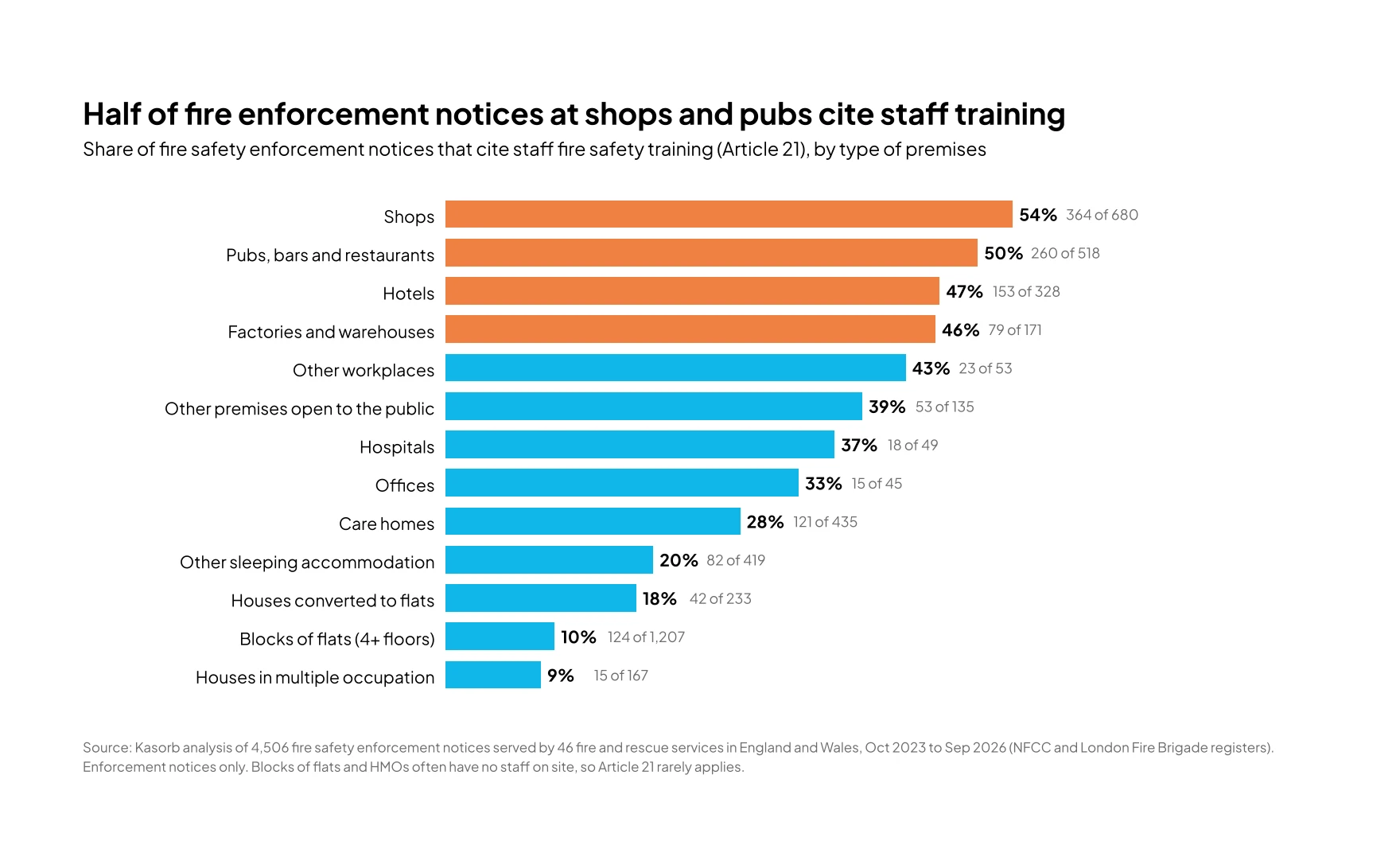
- At shops it was 54% (364 of 680), and at licensed premises such as pubs, bars and restaurants 50% (260 of 518).
- Hotels were close behind at 47% (153 of 328), and factories and warehouses at 46% (79 of 171).
- Across shops, hospitality and other commercial workplaces together, it was 49% (947 of 1,930). At care homes it was 28% (121 of 435).
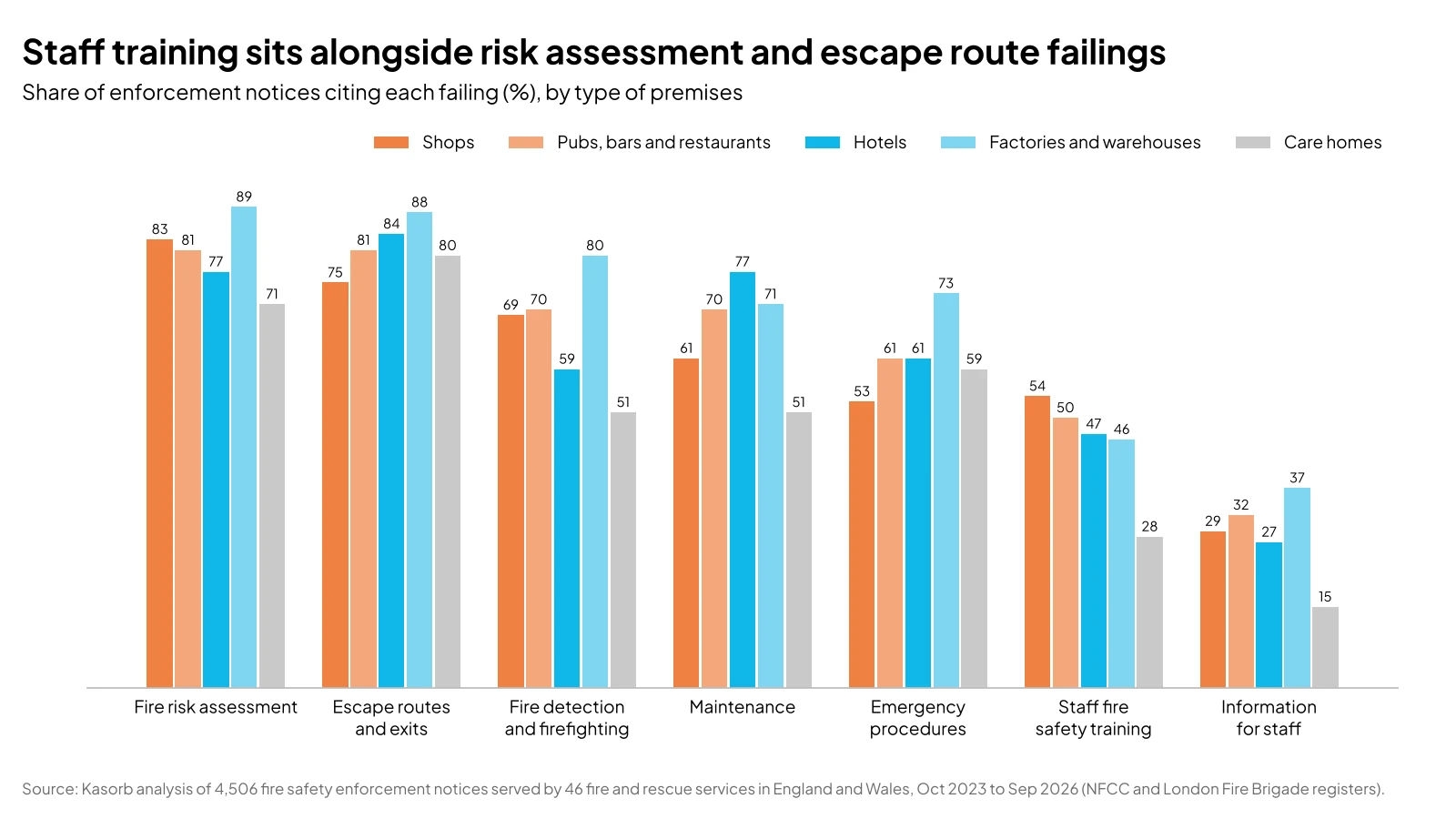
- Staff training was never the only failing. It always came alongside others: at shops, 83% of notices also cited the fire risk assessment and 75% the escape routes.
- The share was steady over time: 30% in 2024, 31% in 2025 and 29% in 2026 so far.
What the law requires
Article 21 of the Fire Safety Order says the responsible person must make sure employees get adequate fire safety training when they start, when the risks they face change, and repeated periodically where appropriate. It must take place during working hours. When a fire service cites Article 21 in an enforcement notice, it has found that this wasn't being done.
An enforcement notice requires the responsible person to put things right by a set date. It isn't a prosecution, and it doesn't mean there has been a fire.
Shops, hospitality and workplaces
The training duty applies to employees, so it shows up most where staff work on site. About half of the notices at shops and licensed premises cited it, and nearly half at hotels and at factories and warehouses. Blocks of flats and houses in multiple occupation, which often have no staff on site, were around 1 in 10.
The pattern isn't just down to which fire services were busiest. Fire services record Article 21 differently, so we also compared premises within the same service. In 9 of the 10 services with at least 10 notices at both shops and care homes, shops had the higher training rate. Restricted to services that cite Article 21 in at least 5% of their notices, the overall rate rises to 33%, with the same order of premises.
Training alongside other failings
No notice cited staff training on its own. It came with failings in the fire risk assessment, escape routes, fire detection, maintenance and emergency procedures. Across all enforcement notices, the most often cited were general fire precautions (78%), escape routes (75%) and the fire risk assessment (72%). Staff training was cited in 30%, and information for staff in 18%.
More on fire marshal training, fire safety awareness training and evacuation chair training.
Care homes
At care homes, 28% of enforcement notices cited staff training (121 of 435). Escape routes (80%), the fire risk assessment (71%) and emergency procedures (59%) were cited more often. Our study of CQC care home reports looks at what inspectors found about staff training more widely.
What to check
Built from what the notices cite, not from Kasorb's courses:
- Every member of staff gets fire safety training when they start, including agency, temporary and seasonal staff, and it's repeated at regular intervals.
- Training covers your own premises: your alarm, your escape routes, your assembly point and what each person does when the alarm sounds.
- Fire marshals or wardens are named for every shift and know their role in an evacuation.
- Staff training is refreshed when something changes, such as a new layout, new equipment, a new use of a room or an updated fire risk assessment.
- Training records show who was trained, when, and what was covered.
- Your fire risk assessment is current and reviewed by someone with the right knowledge, and staff know what it says about their part.
How we did it
- Exported the National Fire Chiefs Council's public register of fire safety enforcement notices, which covers 45 fire and rescue services in England and Wales. Added London Fire Brigade's own register by reading each notice from October 2023 onwards. Notices are generally removed from the registers after three years unless still in force.
- Kept enforcement notices issued from 1 October 2023 to 30 September 2026. These list the articles of the Fire Safety Order that the fire service found weren't being met. The NFCC register lists a notice once for each person it was served on, so repeated records for the same property, date and articles were counted once. Records without a property reference were never merged.
- Counted a notice as citing staff training when Article 21 was among the articles listed. No AI coding was needed: the figures come from the codes the fire services recorded.
- Used premises types as recorded by each fire service. "Pubs, bars and restaurants" is the register's "licensed premises"; unlicensed restaurants and takeaways may be recorded as shops.
Limits. These figures describe enforcement notices, not all businesses: fire services target premises they think are higher risk, and most premises never receive a notice. Fire services record Article 21 differently, from under 1% of notices to around two-thirds, so we haven't compared services or regions. Scotland and Northern Ireland have their own fire safety law and aren't included. A notice is a requirement to put something right, not a finding that anyone was harmed.
Data and credits
- Download the data (CSV): figures by premises type, year and article, with confidence intervals. No premises or business is named.
- Cite as: Kasorb (2026), Fire Safety Training Enforcement Index 2026, kasorb.com/blog/fire-safety-training-enforcement-index. Registers read 27 October 2026.
- Sources: the National Fire Chiefs Council enforcement register and London Fire Brigade public notices. Contains public sector information.
- Author: Steve van de Worp, Head of Learning, Kasorb.
- See also: CQC Training Gap Index 2026 for care homes, CQC Home Care Training Gap Index 2026 and Coroners' Reports Staff Training Index 2026.
FAQs
Is fire safety training a legal requirement for staff?
Yes. Under Article 21 of the Regulatory Reform (Fire Safety) Order 2005, which applies in England and Wales, the responsible person must make sure employees get adequate fire safety training when they start, when the risks change, and repeated periodically where appropriate, during working hours.
How often do fire services cite staff training in enforcement notices?
In 30% of the 4,506 enforcement notices served in England and Wales between October 2023 and September 2026, about 3 in 10.
Which premises have the most staff training failings in fire enforcement notices?
Shops (54% of notices) and licensed premises such as pubs, bars and restaurants (50%), then hotels (47%) and factories and warehouses (46%). At care homes it was 28%.
Does an enforcement notice mean there was a fire?
No. An enforcement notice requires the responsible person to fix failings in fire safety by a set date. It isn't a prosecution and doesn't mean there has been a fire.
Will this be updated?
Yes, every year, at the same address.
On-site training for your whole team at one flat rate. See what's covered, prices and how to book.
See the course

Not sure which course your team needs? Tell us about your setting and we'll confirm within 48 hours.