CQC Home Care Training Gap Index 2026: What Inspectors Found About Staff Training in Home Care


We read what CQC inspectors wrote about staff training in the latest reports for 1,927 home care services in England. At 1 in 5 (421), inspectors recorded a staff training gap. Medicines was the subject named most often, and about a quarter of the gaps involved healthcare tasks such as diabetes, catheter or PEG care.
Key findings
- Inspectors recorded a staff training gap at 21.8% of home care services (421 of 1,927), about 1 in 5.
- Including services where inspectors said the systems for tracking training weren't working, the figure is 23.4% (450).
- Medicines was the subject named most often, at 131 services. In at least 4 in 10 of those, the gap involved competency checks. Then learning disability and autism (73), moving and handling (63), safeguarding (60) and induction or the Care Certificate (55).
- 97 services had a gap in training for a delegated healthcare task: diabetes, catheter care, PEG feeding, stoma care, epilepsy or pressure care. That's 23% of the services with a gap.
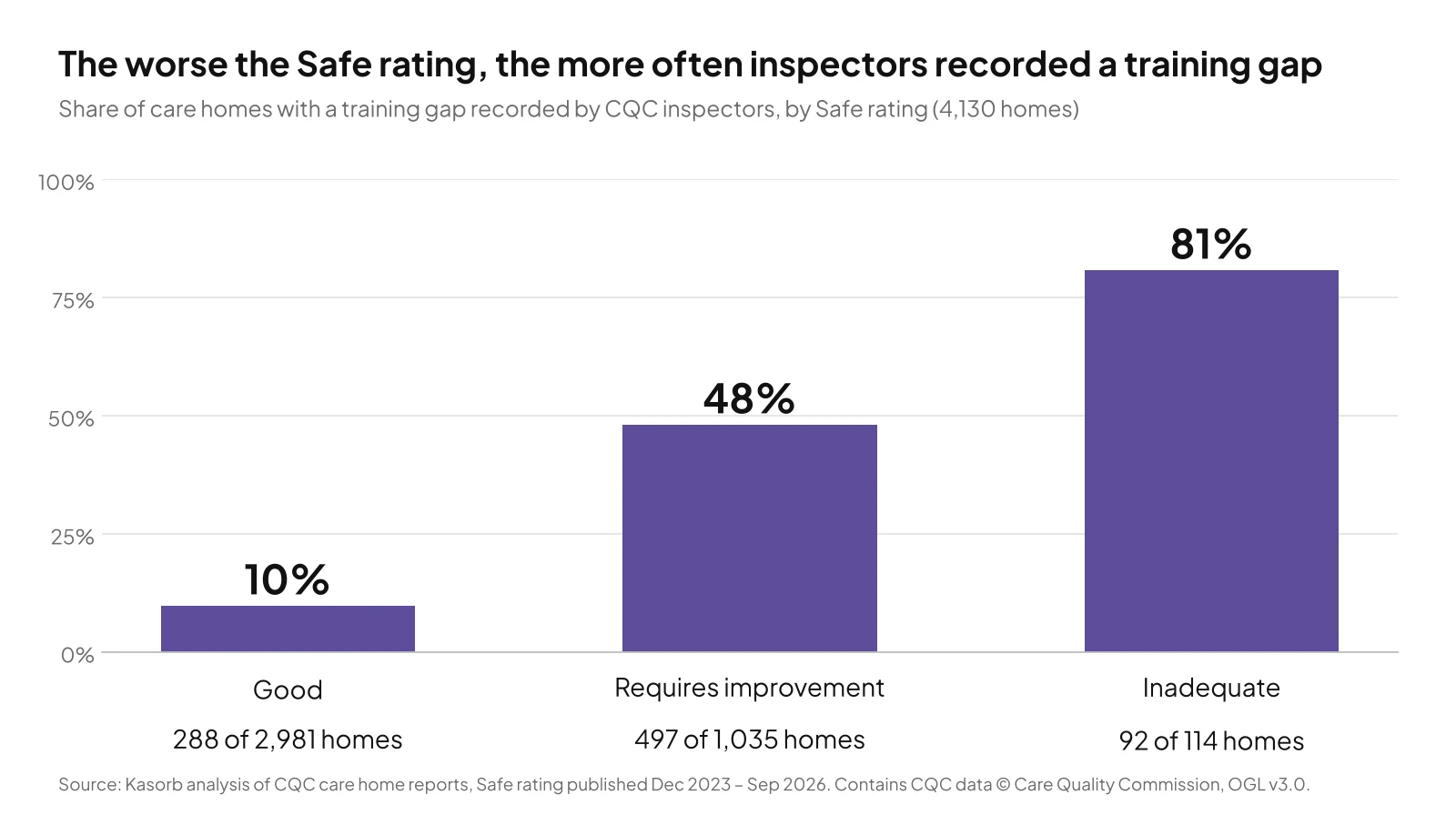
- 13% of services rated Good overall had a staff training gap recorded (189 of 1,466), against 62% of those rated Requires improvement or Inadequate (228 of 369).
- At 70 services (3.6%), inspectors found staff had done the training but weren't applying or understanding it.
- 93 services had gaps in three or more named subjects at once.
What training was missing
Medicines was named at 31% of services with a gap. Learning disability and autism came next (17%), then moving and handling (15%), safeguarding (14%) and induction or the Care Certificate (13%). At 36% of services with a gap, inspectors recorded that mandatory training wasn't complete without naming a subject.

Example wording from CQC reports (no service named):
- "One of the staff started applying the topical medicine before their competency was assessed."
- "staff had not received essential training required to meet specific care needs, such as diabetes."
- "Staff had not received training on learning disabilities and autism, which is a requirement for all staff working in care."
More on medication administration training, safeguarding adults and moving and positioning.
Healthcare tasks at home
Home care staff can be asked to carry out healthcare tasks delegated by nurses, such as checking blood sugar, caring for a catheter or stoma, giving PEG feeds or emergency epilepsy medicine. At 97 services, inspectors recorded a staff training gap in one of these tasks, or in diabetes, epilepsy or pressure care more generally. Diabetes came up at 44 services, catheter and continence care at 34, epilepsy at 23, pressure care at 19, PEG and enteral feeding at 17 and stoma care at 11.
More on diabetes awareness, catheter care, PEG feeding and stoma care.
Services rated Good
A Good rating doesn't mean inspectors found nothing. Among the 1,466 services rated Good overall, inspectors recorded a staff training gap at 189 (13%), about 1 in 8. Among the 369 services rated Requires improvement or Inadequate, it was 228 (62%), about 6 in 10. Of the 92 services rated Outstanding, 4 had a gap recorded.
By region
Share of home care services with a staff training gap recorded by inspectors:
- South West: 29% of 234 services
- West Midlands: 28% of 133
- East of England: 27% of 175
- South East: 25% of 328
- East Midlands: 20% of 161
- Yorkshire and the Humber: 20% of 245
- North West: 19% of 179
- London: 15% of 396
- North East: 12% of 68
Some of the difference between regions may come from how different inspection teams write their reports, so treat these as a guide rather than a ranking. Confidence intervals are in the download below.
What registered managers can do
Built from what inspectors wrote, not from Kasorb's courses:
- Training matrix up to date, with completion and expiry dates for every member of staff, including new starters.
- Medicines training for everyone who supports people with medicines, plus an observed competency check that is written down, before staff do it alone and again when it's due.
- Training for each healthcare task in a person's care plan, such as diabetes, catheter, stoma or PEG care, in place before staff visit that person alone.
- Learning disability and autism training at the right level for each role, required since July 2022.
- Induction and the Care Certificate signed off, with shadowing recorded.
- Moving and handling training that includes practice with the equipment people use at home.
- Certificates on file and easy to find on the day.
How we did it
- Took every community adult social care service in CQC's ratings data (October 2026) with an overall rating published between December 2023 and September 2026: 2,165 of the 10,004 rated services. These are homecare agencies, supported living services, Shared Lives and extra care. 235 had no report under CQC's current assessment approach that we could read, and 3 had Safe, Effective and Well-led all not assessed, leaving 1,927 services: 1,803 homecare, 121 supported living and 3 others.
- Read the overall, Safe, Effective and Well-led pages of each service's latest report on cqc.org.uk, and pulled every sentence mentioning training, competence, induction, refreshers, mandatory training, life support, learning disability or autism. Where only some key questions were assessed, we coded from the pages that were.
- Coded each service: a staff training gap recorded by inspectors (training missing, out of date, overdue or not evidenced, competency checks missing or expired, or induction or the Care Certificate not done or not recorded); weak oversight of training (systems for tracking training not working); and training done but not applied or understood. Where a report said only "most" or "the majority" of staff had done the training, we counted it as a gap. A compliance figure of 90% or more that inspectors reported as positive didn't count. Gaps fixed after inspectors raised them count. Gaps fixed before the assessment, suggestions, and concerns raised only by people, relatives or staff don't.
- Every service was coded twice, independently, using AI-assisted text analysis against the same written guide. The two codings agreed on 99.3% of services for a training gap (kappa 0.98), 98.3% for weak oversight (kappa 0.91) and 99.4% for training not applied (kappa 0.92). The 57 disagreements were reviewed against the guide, with a reason recorded for each.
Limits. CQC doesn't inspect every service each year, so these figures describe services with a recent rating, not all home care services. Reports cover what inspectors chose to write about, so no training finding doesn't prove training was complete. A training gap doesn't mean a service is unsafe, and the data shows where gaps were recorded, not that they caused a rating. England only.
Data and credits
- Download the data (CSV): figures by measure, rating, subject, region and service type, with confidence intervals. No service is named.
- Cite as: Kasorb (2026), CQC Home Care Training Gap Index 2026, kasorb.com/blog/cqc-home-care-training-gap-index. Reports read 26 October 2026.
- Contains CQC data and report text, © Care Quality Commission, used under the Open Government Licence v3.0.
- Author: Steve van de Worp, Head of Learning, Kasorb.
- See also: CQC Training Gap Index 2026 for care homes, CQC GP Training Gap Index 2026 and CQC Dental Training Gap Index 2026.
FAQs
What is the most common staff training gap CQC finds in home care?
Medicines training, including medicines competency checks: the subject named most often, at 131 of the 421 services with a gap (31%).
How many home care services have a staff training gap?
421 of 1,927 services with a recent CQC rating (21.8%), about 1 in 5, had a staff training gap recorded by inspectors.
Do home care services rated Good have training gaps?
Some do. Inspectors recorded a staff training gap at 13% of services rated Good overall (189 of 1,466).
Does a training gap mean a home care service is unsafe?
No. It means inspectors recorded a shortfall in staff training, competency checks, induction or training records at that assessment.
Will this be updated?
Yes, every year, at the same address.
On-site training for your whole team at one flat rate. See what's covered, prices and how to book.
See the course

Not sure which course your team needs? Tell us about your setting and we'll confirm within 48 hours.