Coroners' Reports Staff Training Index 2026

When an inquest reveals a risk that other people could die in the same way, the coroner must write a Prevention of Future Deaths report setting out their concerns. We read the concerns in every one of these reports published since 2020, 3,392 in all, to see how often coroners pointed to staff training. In 1 in 5, they did. It wasn't only hospitals and care services: coroners raised the same concerns about prison officers, police, employers, leisure venues, schools and nurseries.
Key findings
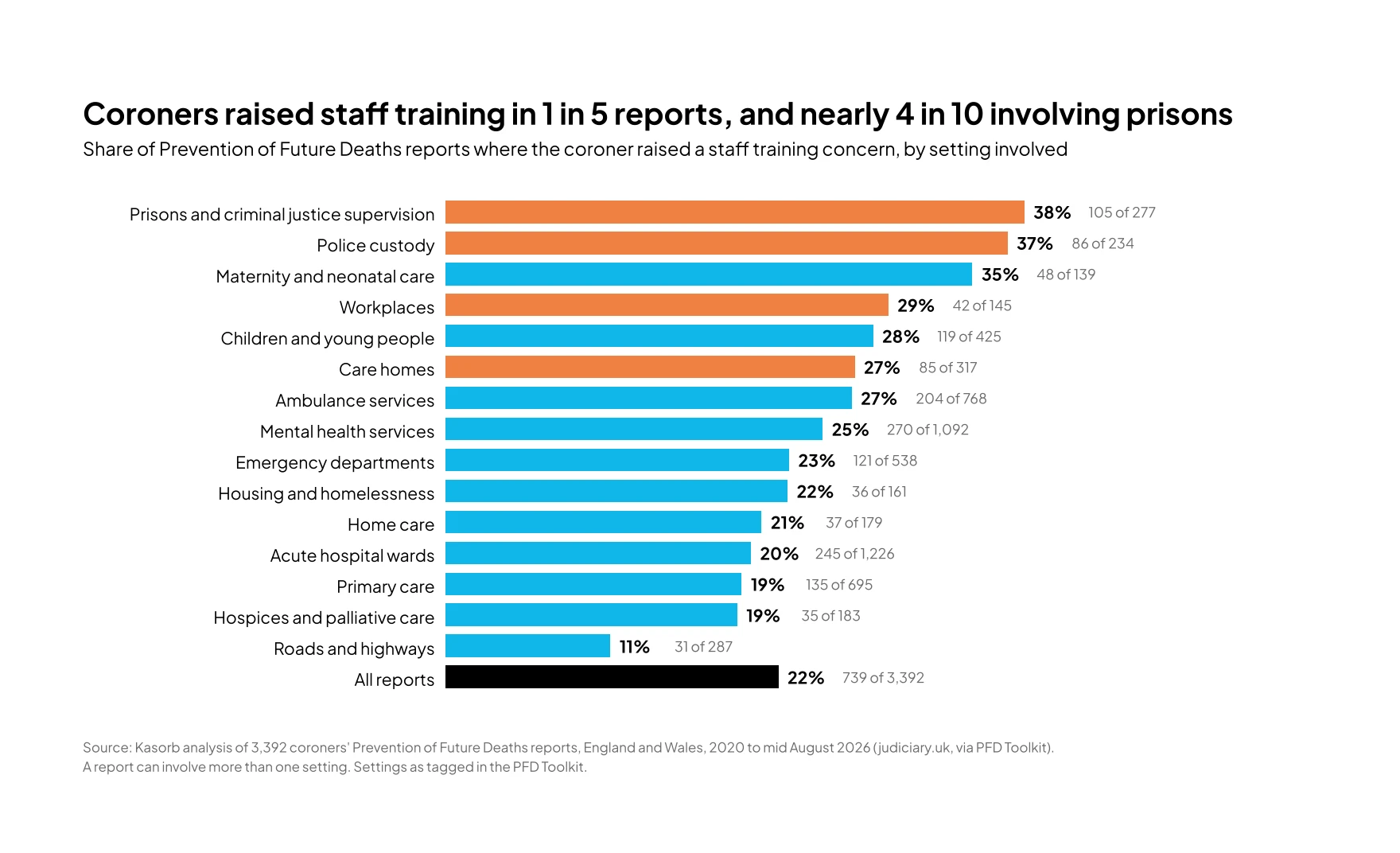
- Coroners raised a staff training concern in 739 of 3,392 Prevention of Future Deaths reports (21.8%), about 1 in 5. In another 13, they said staff had been trained but hadn't applied it.
- The rate was highest in reports involving prisons (38%, 105 of 277) and police custody (37%, 86 of 234). It was 35% in maternity reports, 29% in workplace reports and 27% in care home reports (85 of 317).
- 101 reports raised a gap in CPR and basic life support, first aid, choking or anaphylaxis training. The largest group was prisons (20), then care homes (13), hospitals (12), mental health services (11) and police (10).
- 231 of the 752 training concerns were about staff in prisons, police, workplaces, leisure venues and events, hostels, schools or nurseries, including some healthcare staff working in prisons and police custody.
- The subjects named most often were suicide and self-harm risk (119 reports), specific clinical skills (102), sepsis and recognising deterioration (79) and CPR and basic life support (73).
- The share was between 19% and 24% each year from 2020 to 2026.
What counts as a training concern
We counted a report when the coroner's concerns said staff training was missing, insufficient, out of date or not mandatory; that staff competence wasn't checked; that induction hadn't been done; or that staff lacked the knowledge or skill to do something they needed to do. Concerns only about policies, staffing levels, equipment, records or communication don't count. Nor does training for the public or families.
A training concern is the coroner's view of a risk for the future. It isn't a finding that a training gap caused or contributed to the death.
Where the staff worked
Of the 752 reports with a training concern, the concern was most often about hospital staff (209), then mental health services (114), police (83), prisons (82), care homes (57), primary care (37), home care and supported living (29), ambulance services (27) and workplaces (27). Smaller numbers were about leisure venues, events and sport (15), hostels and supported housing (14), council social workers (12), schools, colleges and universities (8), a nursery (1) and immigration detention (1).
CPR, first aid and choking
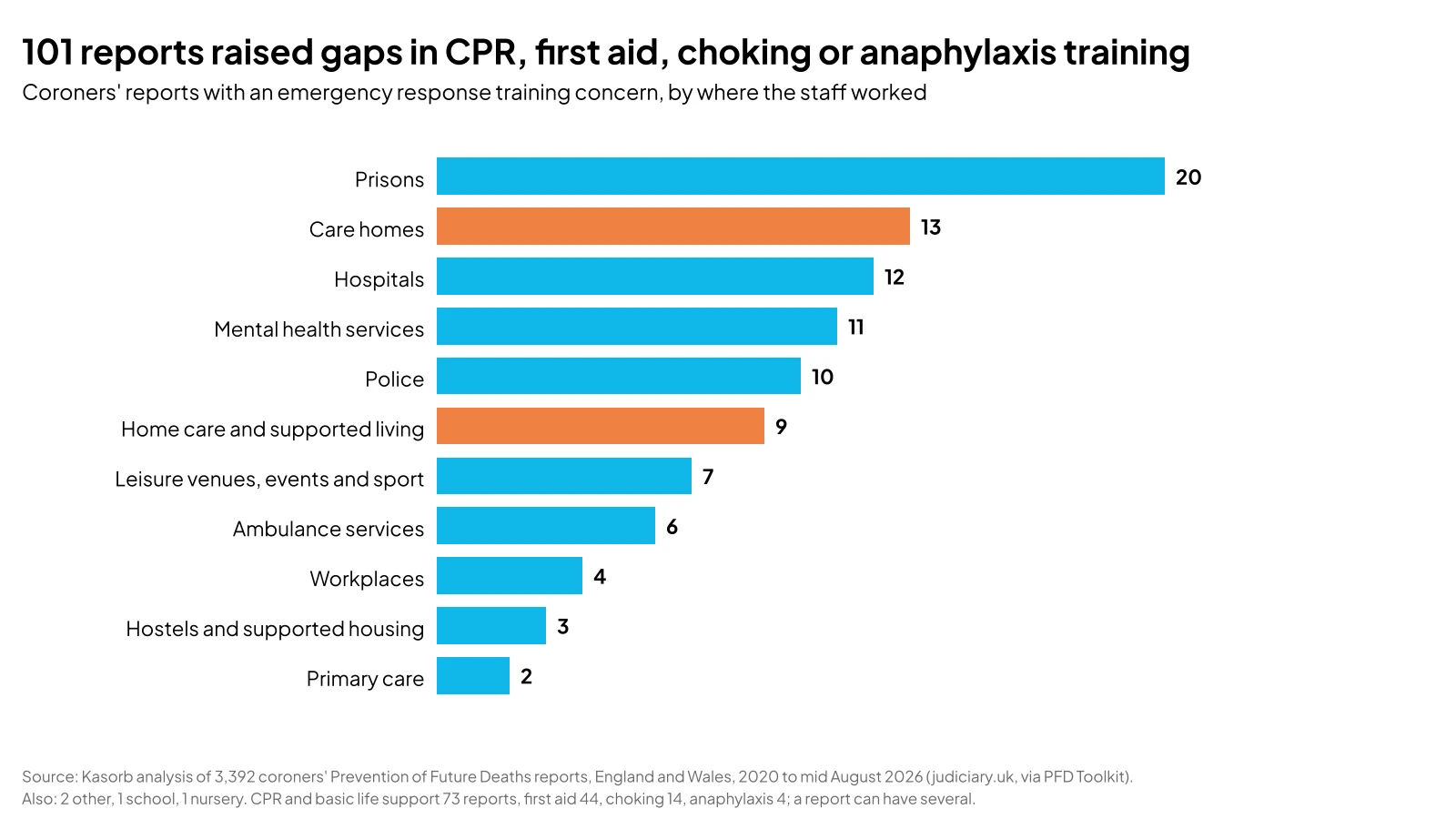
101 reports raised a gap in emergency response training: CPR and basic life support in 73, first aid in 44, choking in 14 and anaphylaxis in 4 (a report can have more than one). Almost half (46) were outside hospitals and care services.
- Prisons (20). In several reports, coroners noted that after their initial training there was "no mandatory refresher training on basic life support for prison officers". Others described officers with no CPR training at all, and confusion over whether to give rescue breaths.
- Care homes (13). Coroners described nurses and senior carers not in date with basic life support and first aid, emergency training that was "not ingrained in care home staff", and staff who still couldn't describe the right treatment for choking when they gave evidence.
- Home care and supported living (9). Carers with no CPR training, staff with first aid training who weren't confident using it, and a lack of understanding of first aid for someone who has become unresponsive.
- Workplaces, leisure and events (11). Duty managers without CPR or first aid training, venue staff with no first aid training, transport crew with no requirement to be first aiders, and sudden cardiac arrest training that isn't required for grassroots football coaches and referees.
- Schools and nurseries (2). A teaching assistant who hadn't been trained in CPR, and nursery staff with no training on weaning and the risk of a child choking on food.
More on basic life support training, First Aid at Work, on-site first aid training, choking and LifeVac training and anaphylaxis training.
Care homes and home care
Coroners raised staff training in 85 of the 317 reports involving care homes (27%) and 37 of the 179 involving home care (21%). Where the concern was about care home staff (57 reports), falls came up most (13), then CPR and life support (11), record keeping (11), recognising deterioration (8), choking (7) and dysphagia (5). Coroners described falls training still outstanding for most staff at the time of the inquest, and policies on what to do after an unwitnessed fall that staff didn't understand. In home care (29 reports), it was first aid (8), falls (5), recognising deterioration (5) and moving someone safely after a fall (3).
More on falls prevention training and sepsis awareness training.
Prisons, police and other settings
In prisons (82 reports), the subjects were mainly suicide and self-harm risk (32), observations and checks (18), CPR (17) and first aid (12). For police (83), they were mental health and suicide risk (24), restraint (14), safeguarding (10), and first aid and CPR (7 each), as well as recognising drug intoxication. In workplaces (27), most were health and safety (12) or driving and transport (7): no rescue drills for machine operators, no structured training for new or unqualified employees, and no regular training on safety-critical procedures.
Hospitals and mental health services
For hospital staff (209 reports), the concerns were most often about a specific clinical skill (78), such as interpreting CTG monitoring or scans, airway management or placing nasogastric tubes, then sepsis and recognising deterioration (42) and medication (22). In mental health services (114), suicide and self-harm risk came first (33), then observations, record keeping, medication and life support (11 each).
What organisations can check
Built from what coroners wrote, not from Kasorb's courses:
- Everyone who might find a person collapsed or unresponsive has in-date CPR and first aid training, with regular refreshers rather than one course at induction.
- Staff practise what they've been trained to do, so it comes back in an emergency: how to treat choking, when to give rescue breaths, and how to use a defibrillator.
- Training matches the risks of the people you support or work with: choking and modified diets, falls and moving someone after a fall, epilepsy, allergy and anaphylaxis, and recognising deterioration and sepsis.
- Agency, bank and new staff have induction and the training their role needs before they work alone.
- Staff know and understand your own policies, such as what to do after an unwitnessed fall, not just that a policy exists.
- A training record that covers every member of staff, with completion and expiry dates, and gaps acted on.
How we did it
- Took every coroners' Prevention of Future Deaths report published on judiciary.uk with a 2020 to 2026 reference number: 3,392 reports, from January 2020 to mid August 2026. We used the open-source PFD Toolkit, which collects the published reports and separates the circumstances, the coroner's concerns and who the report was sent to.
- Read the coroner's concerns, not the circumstances of the death, in every report whose concerns used a training-related word or a variant of one (train, competence, skill, education, CPR, life support, first aid, refresher, course, qualification, induction, knowledge, awareness, understanding, familiarity or instruction): 1,691 reports. We also read 168 reports without those words that the PFD Toolkit tagged for training or competence.
- Each report was coded twice, independently, using AI-assisted text analysis against the same written guide: whether the coroner raised a staff training concern, whether staff had been trained but hadn't applied it, where those staff worked, and which subjects were involved. The two codings agreed on 98% of reports (kappa 0.96). Disagreements were reviewed against the guide and, when in doubt, a report was not counted. A report counts only where both codings found a concern, and a subject only where both named it.
- An independent review of a random sample of 50 coded reports found one counted report that arguably shouldn't have been, and no missed concerns among those not counted.
Limits. Coroners write these reports only where they see a risk of future deaths, so they don't cover every death in any setting. The 1,533 reports with no training words and no training tag weren't read, so a few concerns may be missed. Rates by setting use the PFD Toolkit's own setting tags, which are generated automatically, and a report can involve more than one setting. Years are by the report's reference number, and 2026 runs to mid August. Organisations must respond to a report within 56 days and some may have acted since; we haven't looked at the responses. A training concern is not a finding that training caused or contributed to a death.
Data and credits
- Download the data (CSV): figures by setting, year and subject, with confidence intervals. No person or organisation is named.
- Cite as: Kasorb (2026), Coroners' Reports Staff Training Index 2026, kasorb.com/blog/coroners-reports-staff-training-index. Reports read 27 October 2026.
- Contains public sector information from Prevention of Future Deaths reports published by the Courts and Tribunals Judiciary, licensed under the Open Government Licence v3.0. Reports collected using the open-source PFD Toolkit.
- Author: Steve van de Worp, Head of Learning, Kasorb.
- See also: CQC Training Gap Index 2026 for care homes, CQC Home Care Training Gap Index 2026, CQC Independent Healthcare Training Gap Index 2026, CQC Learning Disability Training Gap Index 2026, CQC GP Training Gap Index 2026 and CQC Dental Training Gap Index 2026.
FAQs
What is a Prevention of Future Deaths report?
When an inquest reveals a risk that other deaths could happen in similar circumstances, the coroner in England and Wales must write a Prevention of Future Deaths report to the people or organisations who can act on it. They must reply within 56 days, setting out what they will do.
How often do coroners raise staff training?
In about 1 in 5 Prevention of Future Deaths reports. Coroners raised a staff training concern in 739 of the 3,392 reports published from 2020 to mid August 2026 (21.8%).
Which settings have the most training concerns?
By number, hospitals (209 reports), mental health services (114), police (83), prisons (82) and care homes (57). As a share of the reports involving each setting, prisons (38%) and police custody (37%) were highest, then maternity (35%), workplaces (29%) and care homes (27%).
How many reports raised CPR or first aid training?
101 reports raised a gap in CPR and basic life support, first aid, choking or anaphylaxis training. CPR and basic life support came up in 73 and first aid in 44. Prisons (20) and care homes (13) had the most.
Does a training concern mean training caused the death?
No. The coroner raises a concern about a risk of future deaths. It isn't a finding that a training gap caused or contributed to the death in that case.
Will this be updated?
Yes, every year, at the same address.
On-site training for your whole team at one flat rate. See what's covered, prices and how to book.
See the course

Not sure which course your team needs? Tell us about your setting and we'll confirm within 48 hours.