CQC Learning Disability Training Gap Index 2026
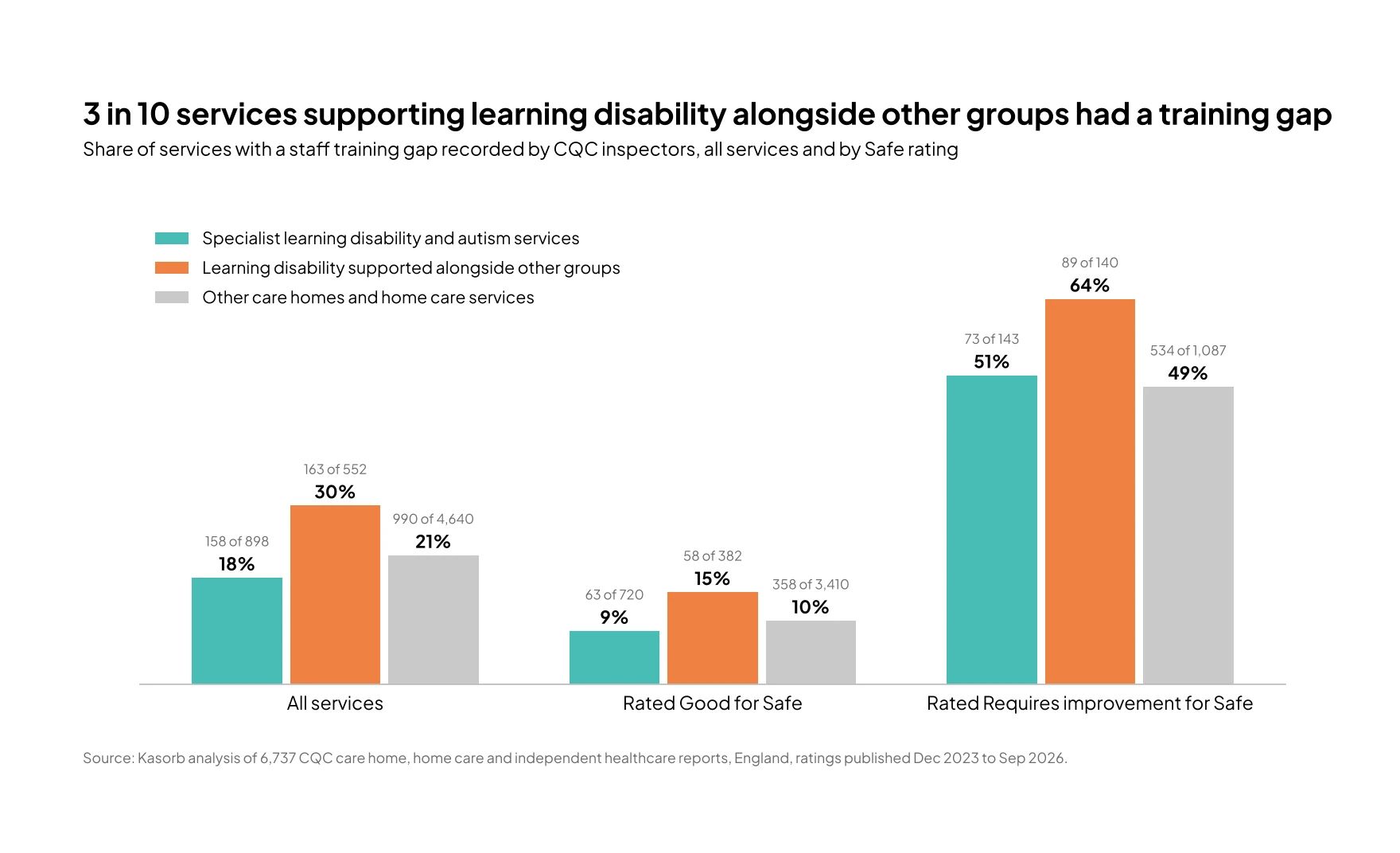

We looked at what CQC inspectors wrote about staff training at 1,450 care homes, supported living and home care services in England that support people with a learning disability or autistic people. Services that support people with a learning disability alongside other groups, such as older people or people living with dementia, were the most likely to have a staff training gap: 3 in 10. At specialist learning disability and autism services it was about 1 in 6.
Key findings
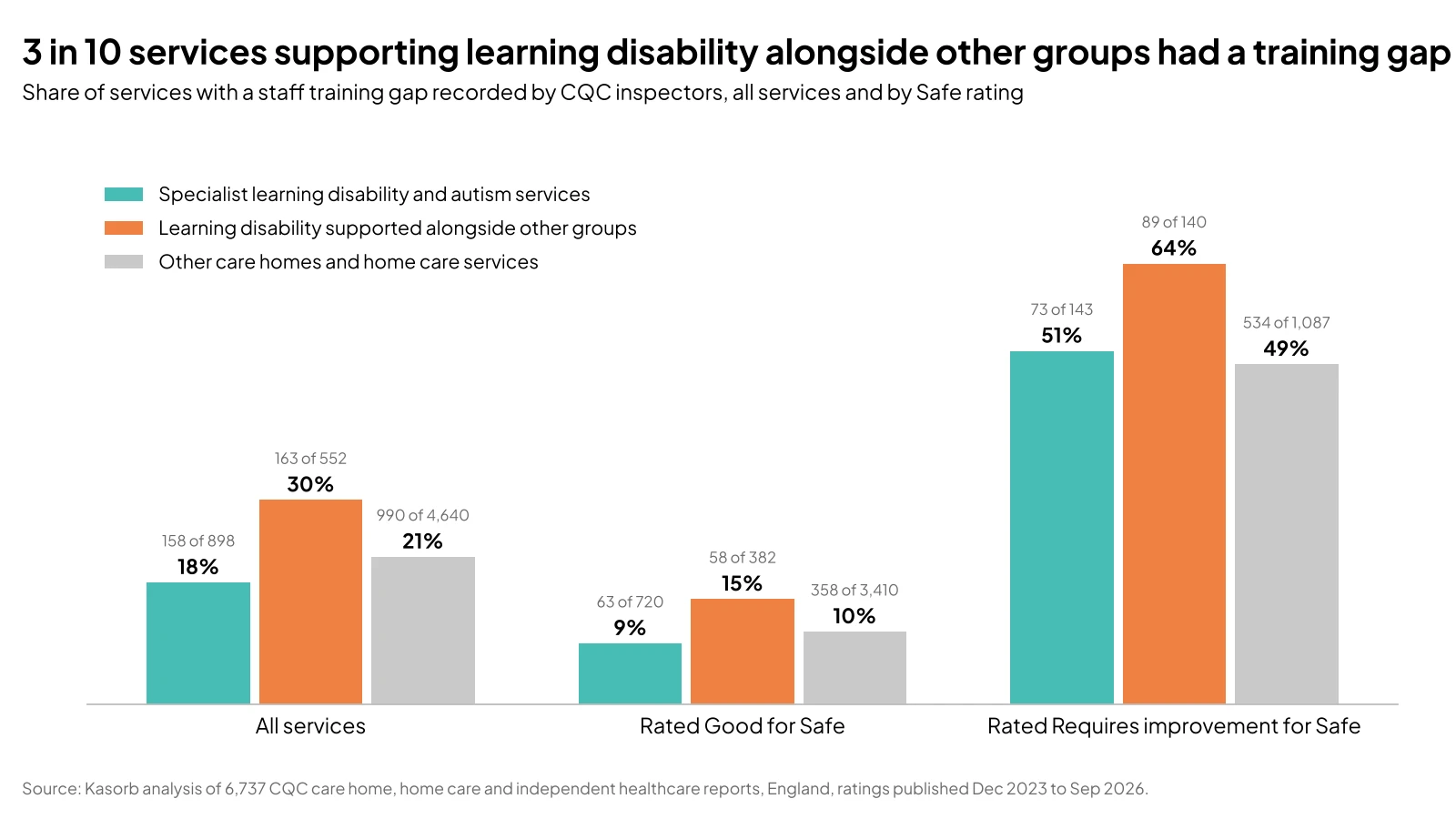
- Inspectors recorded a staff training gap at 29.5% of services that support people with a learning disability alongside other groups (163 of 552), about 3 in 10.
- At specialist learning disability and autism services it was 17.6% (158 of 898), about 1 in 6. At other care homes and home care services it was 21.3% (990 of 4,640).
- The difference holds within the same Safe rating. Among services rated Good for Safe, 15% of mixed services had a gap, against 9% of specialist services and 10% of others. Among those rated Requires improvement, it was 64%, 51% and 49%.
- Learning disability and autism training was the gap at 1 in 4 of the mixed services with a gap (40 of 163). Often staff were supporting someone with a learning disability without having had that training.
- At specialist services, 4 in 10 gaps (67 of 158) involved a skill specific to supporting people with a learning disability or autistic people: learning disability and autism, positive behaviour support or restrictive practice, communication, epilepsy, or dysphagia and choking.
- The Oliver McGowan training was named in 24 of the gaps.
Mixed services: learning disability alongside other groups
These are care homes and home care services whose CQC report says they support people with a learning disability or autistic people as one group among several: for example, a care home for older people that also supports some people with a learning disability, or a home care agency whose clients include older people, people with physical disabilities and people with a learning disability.
Inspectors recorded a staff training gap at 163 of the 552 (29.5%). Medication was the subject named most often (45 services), then learning disability and autism training (40), diabetes (20), moving and handling (17), epilepsy (15), safeguarding (15) and catheter care (14). In 49 the gap was in mandatory training with no subject named.
Example wording from CQC reports (no service named):
- "Only the registered manager had completed specific training relating to learning disability and autism, despite staff supporting a person with a learning disability at the service."
- "Some staff's breakaway and restraint training was not up to date…"
Specialist learning disability and autism services
These are services CQC describes as mainly for people with a learning disability and autistic people: small care homes, supported living and home care services. Inspectors recorded a staff training gap at 158 of the 898 (17.6%): 131 of 771 care homes (17.0%) and 18 of 113 supported living and home care services (15.9%).
That is lower than for other services overall, mainly because more specialist services are rated Good for Safe (81%, against 73% of other services). Within each rating, specialist services were close to other services.
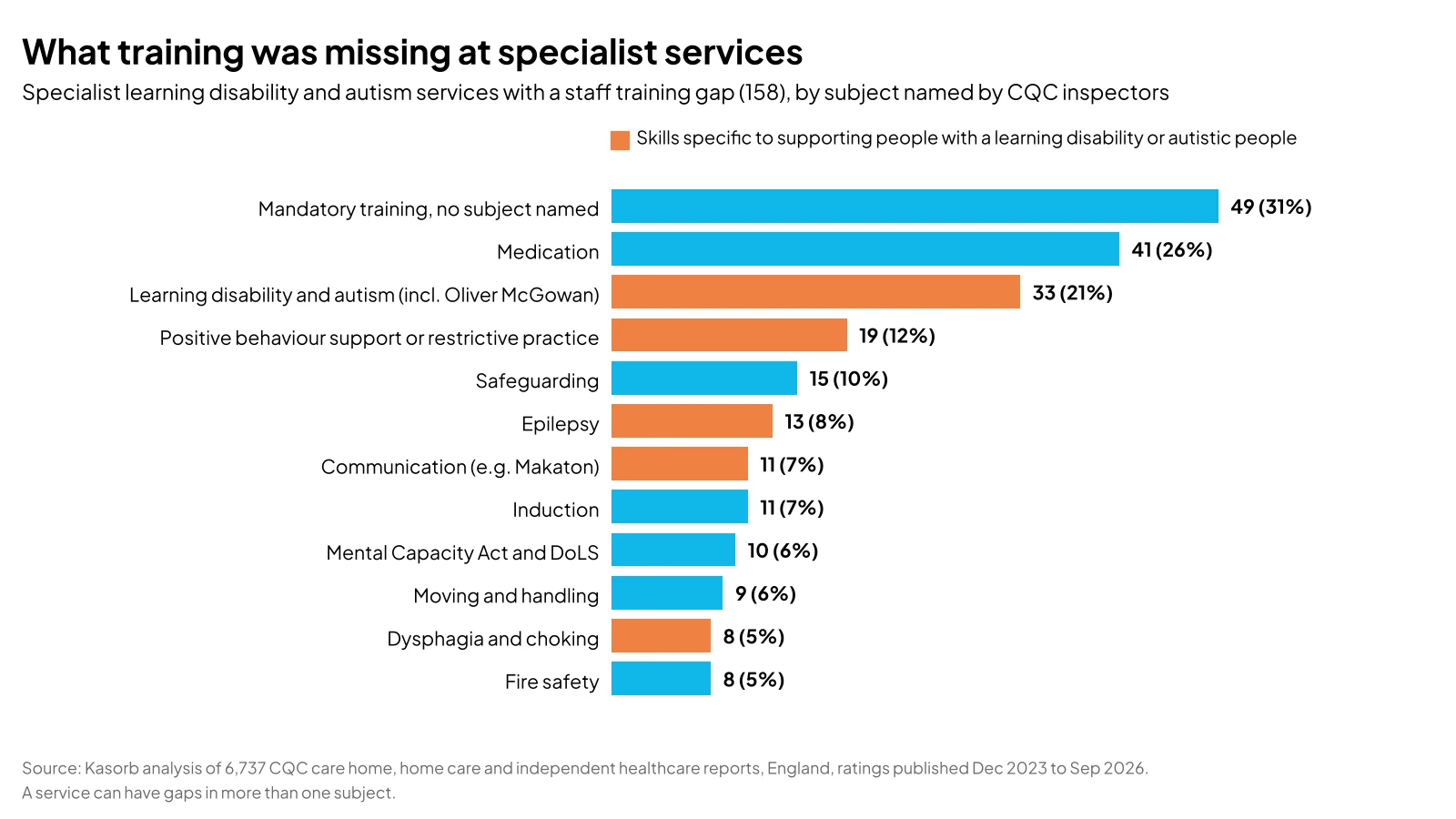
Medication was named at 26% of specialist services with a gap, then learning disability and autism training (21%, including 11 where the Oliver McGowan training was named), positive behaviour support or restrictive practice (12%), safeguarding (10%), epilepsy (8%), communication such as Makaton (7%) and dysphagia and choking (5%). Restraint findings included an agency worker who hadn't completed the restraint training the service used.
Example wording from CQC reports (no service named):
- "We also identified that only 66% of staff had received Tier 2 Oliver McGowan training."
- "The provider was aware staff had not received any formal Makaton training which 1 person who regularly stayed in the care home used to communicate."
- "There were also gaps in epilepsy training, with rota records showing staff without appropriate training supporting individuals with this condition across multiple weeks."
- "Staff had not completed epilepsy training, despite having people within the service with this health condition."
More on positive behaviour support training, autism awareness training, epilepsy awareness training, buccal midazolam training, dysphagia training and medication administration training. Autism awareness training doesn't replace the Oliver McGowan Mandatory Training.
What registered managers can do
Built from what inspectors wrote, not from Kasorb's courses:
- If you support even one person with a learning disability or an autistic person, make sure every member of staff who supports them has learning disability and autism training at the right tier, including the Oliver McGowan training. It has been required for staff at CQC-registered services since July 2022.
- Match training to each person's needs: epilepsy and rescue medication, dysphagia and modified diets, PEG feeding, communication methods such as Makaton, and positive behaviour support, before staff support that person.
- Where staff use restraint, training that meets the Restraint Reduction Network standards and matches your own policy, including for agency staff.
- Medicines training and competency checks for every staff member who gives medicines, including rescue medicines.
- A training matrix covering every staff member, including bank and agency staff, with completion and expiry dates, and gaps acted on before they show up at inspection.
- Agency and new staff inducted, with the induction recorded, before they work a shift.
How we did it
- Started from the services in Kasorb's three earlier CQC studies: 4,135 care homes (Safe ratings published December 2023 to September 2026; 11 of the 4,146 in that study are left out because their report text wasn't saved), 1,927 home care services (homecare agencies, supported living, Shared Lives and extra care) and 679 independent healthcare locations: 6,737 services in all, as 4 appeared in two studies. Their staff training codes are the ones used in those studies, unchanged.
- Read the overview page of each service's latest CQC report on cqc.org.uk. CQC doesn't publish a list of learning disability services, and its "Right support, right care, right culture" wording appears in almost every home care report, so we used CQC's own description of each service. The 1,927 overviews that mention learning disability or autism were sorted into: specialist (mainly for people with a learning disability and/or autistic people), mixed (learning disability or autism is one group among several), or neither.
- Every service was sorted twice, independently, using AI-assisted text analysis against the same written guide. The two agreed on 96% of services, and on 99% for specialist or not (kappa 0.98). Disagreements were reviewed against the guide; when in doubt, a service was counted as mixed rather than specialist. 887 of the 898 specialist services are registered with CQC to support people with a learning disability.
- For the 321 specialist and mixed services with a staff training gap, the subjects named by inspectors were coded twice, independently, against a finer list (Oliver McGowan, other learning disability and autism training, positive behaviour support, restrictive practice, communication, epilepsy, dysphagia and choking, and the usual subjects). Agreement by subject was kappa 0.92 to 1.00. A subject counts only where both codings named it.
Limits. These figures cover services with a recent rating that were in our earlier studies, not every learning disability service in England. Care home reports were read on the Safe and Effective pages, and home care reports on the overall, Safe, Effective and Well-led pages. Reports cover what inspectors chose to write about, so no training finding doesn't prove training was complete. 14 specialist services are independent healthcare services; there are too few to report on their own, but they are included in the totals. A training gap is a shortfall recorded at that assessment, not a finding that anyone was harmed.
Data and credits
- Download the data (CSV): figures by group, setting, Safe rating and subject, with confidence intervals. No service is named.
- Cite as: Kasorb (2026), CQC Learning Disability Training Gap Index 2026, kasorb.com/blog/cqc-learning-disability-training-gap-index. Reports read 27 October 2026.
- Contains CQC data and report text, © Care Quality Commission, used under the Open Government Licence v3.0.
- Author: Steve van de Worp, Head of Learning, Kasorb.
- See also: CQC Training Gap Index 2026 for care homes, CQC Home Care Training Gap Index 2026, CQC Independent Healthcare Training Gap Index 2026, CQC GP Training Gap Index 2026 and CQC Dental Training Gap Index 2026.
FAQs
How many learning disability services have a staff training gap?
About 1 in 6 specialist learning disability and autism services (158 of 898, 17.6%) had a staff training gap recorded by CQC inspectors at their latest assessment. At services that support people with a learning disability alongside other groups, it was about 3 in 10 (163 of 552, 29.5%).
What training is most often missing at learning disability services?
At specialist services, medication (26% of those with a gap), then learning disability and autism training (21%) and positive behaviour support or restrictive practice (12%). At mixed services, medication (28%) and learning disability and autism training (25%).
Is the Oliver McGowan training mandatory?
The Health and Care Act 2022 requires CQC-registered providers to make sure staff receive learning disability and autism training appropriate to their role. The government names the Oliver McGowan Mandatory Training as its preferred and recommended package. Inspectors named it in 24 of the gaps in this study.
Does a training gap mean a service is unsafe?
No. It means inspectors recorded a shortfall in staff training, competency checks, induction or training records at that assessment.
Will this be updated?
Yes, every year, at the same address.
On-site training for your whole team at one flat rate. See what's covered, prices and how to book.
See the course

Not sure which course your team needs? Tell us about your setting and we'll confirm within 48 hours.