FEV1/FVC Ratio: How to Read Spirometry Results

The FEV1/FVC ratio compares how much air someone can blow out in the first second of a forced breath (FEV1) with the total they can blow out (FVC). A low ratio means air is leaving the lungs too slowly, an obstructive pattern seen in COPD and asthma. A normal ratio with a low FVC can point to restriction, which needs further tests to confirm.
Spirometry is a breathing test used to check how well the lungs are working. This guide explains the numbers on the report, the patterns they show, the debate over 0.7 versus the lower limit of normal, reversibility testing, how to prepare someone for a test and why quality matters so much.
What spirometry measures
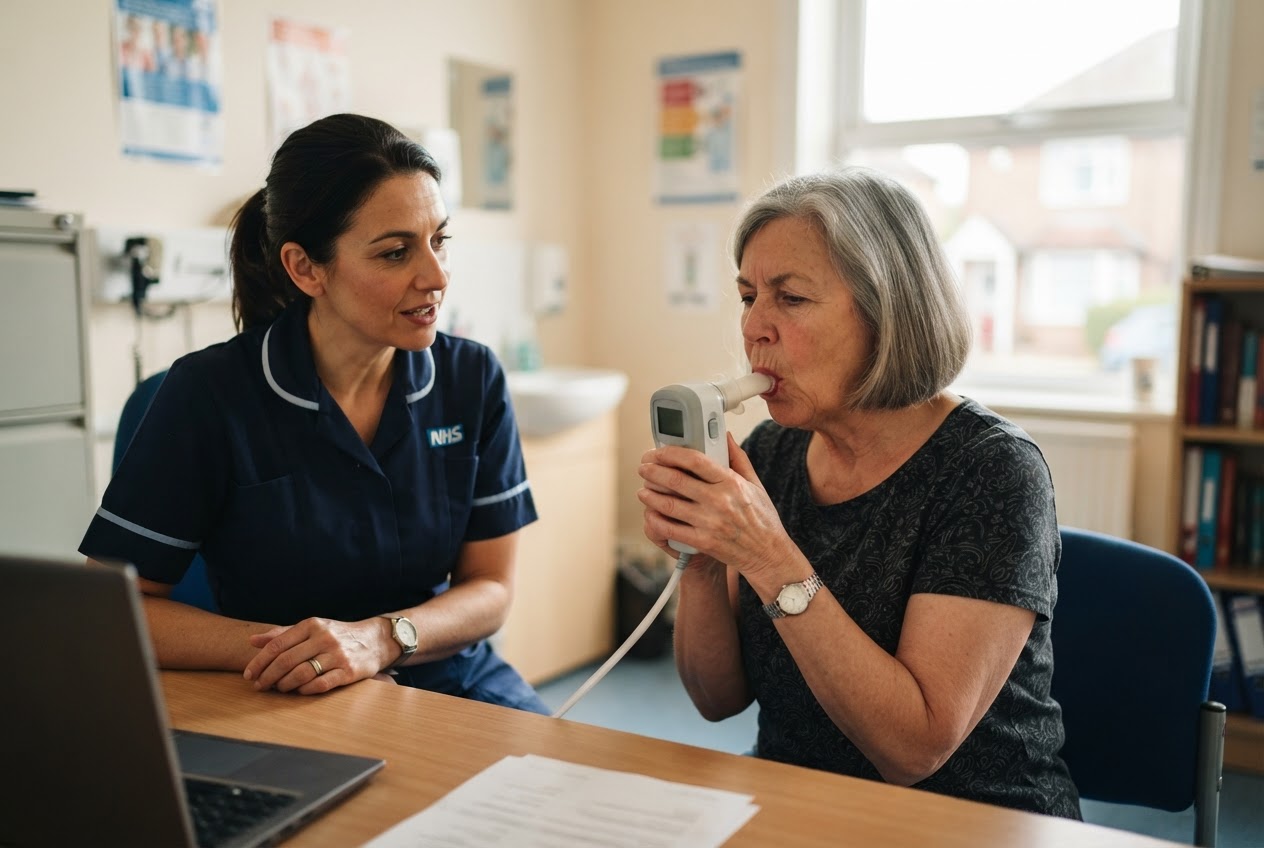
The NHS describes the test simply: the person takes a deep breath in until their lungs are full, then breathes out as quickly and strongly as they can until they're empty. They then repeat it two more times. Sometimes they then use an inhaler and repeat the test after a short break.
- FEV1 (forced expiratory volume in one second): how much air is blown out in the first second.
- FVC (forced vital capacity): the total amount blown out in the whole breath.
- FEV1/FVC ratio: the proportion of the total that comes out in the first second.
Each result is compared with the value expected for someone of the same age, height, sex and ethnicity. The European Respiratory Society and American Thoracic Society's 2022 standard on interpreting lung function tests recommends the Global Lung Function Initiative (GLI) reference equations for this.
What the patterns mean
- Normal: FEV1, FVC and the ratio all fall within the expected range.
- Obstructive: the ratio is low because air can't leave the lungs quickly enough, usually because the airways are narrowed. This is the pattern in COPD and asthma.
- Restrictive: the total volume is reduced because the lungs can't fully expand, while the ratio is normal or high. But a low FVC on spirometry alone doesn't prove restriction. The ERS/ATS standard says restriction is confirmed by measuring total lung capacity, a different test.
- Mixed: both the total volume and how fast air can be blown out are reduced.
There's also a "non-specific" pattern: reduced FEV1 or FVC with a normal ratio. In people who smoke or used to, this is often called preserved ratio impaired spirometry (PRISm). It can reflect poor effort, restriction or early airway disease, which is another reason good coaching matters.
0.7 or the lower limit of normal?
This is where clinicians disagree, and it's worth understanding both positions.
The fixed ratio of 0.7. NICE's COPD guideline confirms the diagnosis with post-bronchodilator spirometry and uses a ratio below 0.7. But NICE adds two caveats: think about other diagnoses in older people with a ratio below 0.7 but no typical symptoms, and still think about COPD in younger people with symptoms whose ratio is above 0.7.
The lower limit of normal (LLN). The 2022 ERS/ATS standard defines obstruction as a ratio below the LLN, which is the 5th percentile of healthy people of the same age, height and sex (a z-score of about -1.645). It strongly discourages the 0.70 cut-off.
In practice, follow the guidance your service and its clinical leads use, and make sure the report says which method it applied. NICE's caveats show why one fixed number can mislead at either end of the age range.
Bronchodilator reversibility
A reversibility test repeats spirometry after a reliever inhaler, to see how much the airways open up. Asthma + Lung UK describes giving the reliever through a spacer and waiting 15 to 20 minutes before the second test.
- Asthma: the joint BTS, NICE and SIGN guideline (NICE NG245) says to diagnose asthma in adults if FEV1 rises by 12% or more and 200 ml or more from the pre-bronchodilator result, or by 10% or more of the predicted normal FEV1. In adults, blood eosinophils or FeNO are tested first, with reversibility used if those don't confirm asthma.
- COPD: NICE says routine reversibility testing isn't usually needed to diagnose COPD, and a single test can mislead unless FEV1 changes by more than 400 ml.
Preparing someone for a test
Good results start before anyone picks up a mouthpiece. The NHS advises people:
- not to smoke for 24 hours before the test
- not to drink alcohol for at least 4 hours before
- not to eat a large meal for at least 2 hours before
- to wear loose clothing
The person will be told whether to stop any medicines or inhalers beforehand, so don't guess. The NHS also says spirometry isn't safe for someone with a chest infection or who has recently had a heart attack or stroke, and that people may feel dizzy or faint during or shortly after the test. If someone you support is having the test, follow the clinic's instructions and your local policy, and make sure they have their inhalers and spacer with them.
Why test quality matters
A spirometry result is only as good as the blows behind it. A half-hearted breath, a slow start or stopping early can make healthy lungs look diseased, or hide a real problem. The ATS/ERS 2019 standard on performing spirometry sets out the basics:
- aim for at least three acceptable blows
- the two largest FEV1 and FVC values should be within 150 ml of each other (for people over 6)
- usually no more than eight attempts for adults
- stop if the person feels pain
NICE's COPD quality standard says spirometry should be done by a healthcare professional with appropriate training and backed by a quality-control process. The spirometer itself needs regular calibration or verification. Infection control matters too: the ATS/ERS standard lists active transmissible infection as a reason to think carefully before testing, and our infection control training covers the principles.
In England, NHS England's commissioning standards for spirometry say results should be interpreted and reported by a trained healthcare professional, and point to ARTP (Association for Respiratory Technology and Physiology) spirometry certification and the ARTP register. If staff perform or interpret diagnostic spirometry, check what your commissioners and local policy expect.
Smoking is the main risk factor NICE names for COPD, so a spirometry appointment is also a good moment for a conversation about stopping. Our smoking cessation training helps staff do that well.
How Kasorb can help
Our Spirometry course teaches nurses and healthcare staff to perform quality spirometry: calibrating the spirometer, preparing the patient, coaching the manoeuvre, assessing whether each blow meets quality criteria, reversibility testing and recognising normal, obstructive and restrictive patterns. It also covers indications, contraindications, infection control, and recording and reporting results.
It runs on-site anywhere in the UK for up to 10 staff, as a first course or a refresher, at one price for the group, and practising on your own spirometer is best. Each member of staff coaches and records spirometry under observation, with feedback. Your trainer has used these skills for real. Certificates are emailed the next day, ready for your own supervised sign-off. It isn't ARTP certification.
FAQs
What is a normal FEV1/FVC ratio?
There isn't one number for everyone, because the expected ratio depends on age, height and sex. NICE's COPD guideline uses a post-bronchodilator ratio below 0.7, while the ERS/ATS standard recommends comparing against the lower limit of normal for that person.
What does a low FEV1/FVC ratio mean?
A low ratio means a smaller share of the air comes out in the first second, so air is leaving the lungs too slowly. This is an obstructive pattern, seen in conditions such as COPD and asthma. A clinician interprets it alongside symptoms, history and reversibility testing.
What does a restrictive spirometry result mean?
A restrictive pattern shows a reduced total volume (FVC) with a normal or high ratio, suggesting the lungs can't fully expand. Spirometry alone can't confirm restriction. The ERS/ATS standard says it is confirmed by measuring total lung capacity, so further tests are usually needed.
What counts as a positive reversibility test for asthma?
NICE guidance (NG245) says to diagnose asthma in adults if FEV1 rises by 12% or more and 200 ml or more after a bronchodilator, or by 10% or more of the predicted normal FEV1. It is used if blood eosinophils or FeNO don't confirm asthma first.
Can you smoke before a spirometry test?
No. The NHS advises not smoking for 24 hours before a spirometry test, not drinking alcohol for at least 4 hours and not eating a large meal for at least 2 hours. The clinic will say whether to stop any inhalers or medicines beforehand.
On-site training for your whole team at one flat rate. See what's covered, prices and how to book.
See the course

Not sure which course your team needs? Tell us about your setting and we'll confirm within 48 hours.