Wheelchair Accessible Vehicle Safety: A Guide for Care Teams
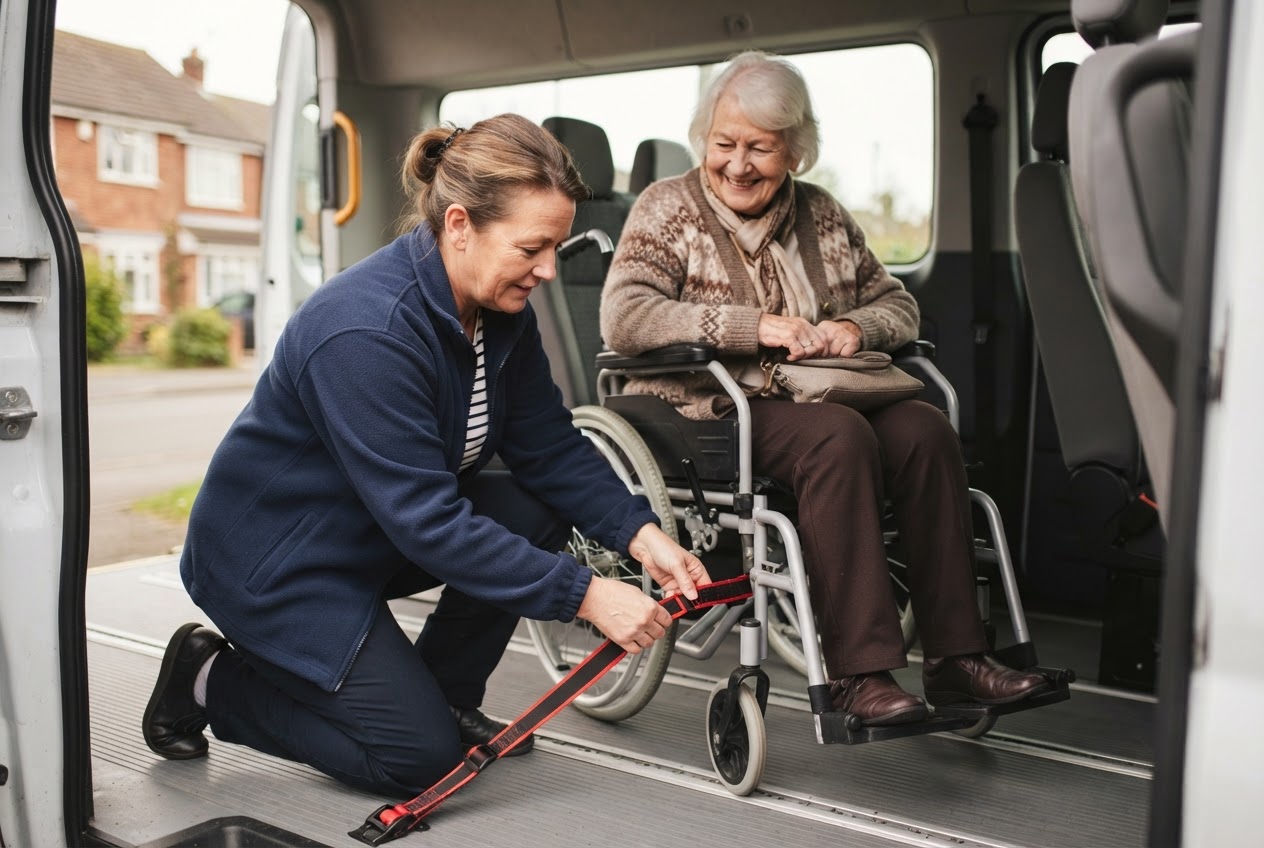

Keeping someone safe in a wheelchair accessible vehicle comes down to four things: a wheelchair that's suitable for use as a seat in a vehicle, a four-point tie-down holding it to the floor, a separate lap and diagonal belt holding the person, and staff trained to fit and check all of it on every journey. If the person can move to a vehicle seat, that's safer still.
First question: can the person transfer?
Not every wheelchair is designed to be a seat in a moving vehicle. The Medicines and Healthcare products Regulatory Agency (MHRA) guidance on occupied wheelchairs in transport says users should transfer to a vehicle seat where possible, with the wheelchair stowed as luggage.
If someone can't transfer safely, that's a decision to record. Carry out a risk assessment with the people involved, including the person, their family and anyone who prescribed the wheelchair. The Health and Safety Executive for Northern Ireland (HSENI) puts it simply: the benefits must outweigh the risks. Moving someone between chair and seat is a moving and handling task too, so make sure staff are trained in moving and positioning people.
Is the wheelchair suitable for travel?
Before the first journey, check:
- The instructions for use. The manufacturer should say whether the chair can be occupied in transport, what extra equipment it needs, where the anchor points are and any limits such as maximum user weight.
- Crash testing. Wheelchairs meant for occupied transport should have passed a dynamic crash test to ISO 7176-19 or the equivalent US standard. Tie-down points should be marked with a karabiner symbol.
- Compatibility. A crash-tested chair still may not suit every tie-down or docking system. Where a seating system is fitted to a different base, MHRA guidance says whoever puts them together is responsible for the combination being safe.
- Any wheelchair passport. Some services use a passport attached to the chair that records how to secure the person and the chair. BS 8603:2020 is the British Standard code of practice for these schemes.
Securing the wheelchair: tie-downs
The most common wheelchair tie-down is a four-point strap system: two straps at the front and two at the rear, anchored to the vehicle floor. Together with the occupant restraint, this is known as a wheelchair tie-down and occupant restraint system, or WTORS.
- Face the wheelchair forwards. International best practice guidance (BPG1, which the MHRA lists as further reading) says passengers shouldn't travel side-facing in any vehicle, or rear-facing in a taxi.
- Attach tie-downs to the frame at the marked points, never to removable parts such as armrests, footrests or wheels.
- Switch off a powered chair, make sure it isn't in freewheel mode, and apply the brakes.
- Carry a complete set of the right restraints for each wheelchair: front tie-downs, rear tie-downs and the occupant restraint.
Securing the person: occupant restraint
The tie-downs stop the chair moving. They do nothing to hold the person. For that you need a separate, crashworthy lap and diagonal belt.
- Postural belts aren't restraints. MHRA guidance says lap belts and postural aids supplied with a wheelchair aren't intended for crash protection. Use them for posture as well, not instead.
- Anchor the belt properly. Follow the manufacturer's instructions for the belt anchor points. Best practice guidance strongly discourages anchoring the upper shoulder belt to the floor.
- Support the head. Where a wheelchair is used regularly in transport, a head support that can act as a head restraint should be considered necessary, to reduce the risk of neck injury in a rear impact.
- Remove trays and accessories and stow them securely, unless a risk assessment shows a tray gives postural benefit that outweighs the added risk.
People with complex seating needs, such as some people with a spinal injury, may need bespoke restraints. Talk to the wheelchair service and the WTORS manufacturer before you improvise anything.
Ramps and passenger lifts
Loading and unloading is a moving and handling task in its own right. Follow the manufacturer's instructions for the ramp or lift, keep the area clear, and make sure staff know how to control a wheelchair on a slope. Our manual handling training covers safe pushing and pulling.
A powered lift that raises a person is lifting equipment. HSE guidance on lifting people says equipment used to lift people must be thoroughly examined at least every six months, or in line with a written examination scheme. That comes from the Lifting Operations and Lifting Equipment Regulations 1998 in Great Britain; Northern Ireland has its own equivalent.
Checks before every journey
- The wheelchair, the vehicle and the WTORS are suitable for each other and for this person.
- Tie-downs, belts and anchor points are free from damage, wear or fraying. Record the check and take faulty equipment out of use.
- The ramp or lift works and its examination is in date.
- Brakes are on, powered chairs are switched off, and loose items are stowed.
- A second person has checked the fitting. HSENI advises a tug test on each restraint once it's fitted.
- The person is comfortable and knows what's happening.
After a collision
Even a minor bump can damage a wheelchair or its restraints in ways you can't see. MHRA guidance says don't use the wheelchair or WTORS again until the manufacturer, or a repair agent it authorises, has checked them, and if in doubt, scrap them. Report the incident to the MHRA as well as through your own system. In Northern Ireland, HSENI's alert on occupied wheelchairs also asks you to tell HSENI so it can decide whether the incident is reportable under RIDDOR.
The law and your responsibilities
A wheelchair accessible vehicle and its securement system are work equipment. In Great Britain, the Provision and Use of Work Equipment Regulations 1998 require employers to make sure everyone who uses work equipment, and anyone who supervises its use, has adequate training in how to use it, the risks and the precautions to take. Equivalent regulations apply in Northern Ireland. Health and safety law also protects the people you transport, not just your staff.
In England, CQC's Regulation 12 expects providers to make sure the equipment they use to provide care is safe and used safely. The Care Inspectorate in Scotland, CIW in Wales and RQIA in Northern Ireland expect the same. In practice that means a transport risk assessment for each person who travels in their wheelchair, regular equipment checks, and staff who have practised on the equipment they actually use.
This guide summarises the law and guidance; it isn't legal advice.
How Kasorb can help
Our wheelchair securement training teaches drivers, escorts and support staff to secure a wheelchair and its passenger safely using your WTORS. It covers safety and liability, the types of securement equipment, occupant restraints and accessories, operating your system, and securing both the wheelchair and the occupant. It's practical: half a day in your own vehicle, with your own wheelchairs, checked through observed practice and questions. Your trainer has used these skills for real.
Staff need moving and handling training covering objects and people within the last 12 months first. It runs on-site anywhere in the UK at one flat rate for the group, and certificates are emailed the next day.
FAQs
How many tie-downs does a wheelchair need in a vehicle?
The most common system uses four straps, two at the front and two at the rear, anchored to the vehicle floor. Some wheelchairs or users need more, so check the wheelchair's instructions for use. The tie-downs hold the chair only; the person needs their own lap and diagonal belt.
Can a wheelchair lap belt be used as a seat belt in a vehicle?
No. Lap belts and postural belts supplied with a wheelchair help with seating and posture. They aren't designed to hold someone in a crash. Use a crash-tested lap and diagonal occupant restraint fitted to the vehicle or the tie-down system, as well as any postural belt the person needs.
Should a wheelchair user stay in their wheelchair when travelling?
Where possible and practical, guidance from the MHRA recommends transferring to a vehicle seat and stowing the wheelchair securely as luggage. If the person can't transfer safely, carry out and record a risk assessment, and check the wheelchair is suitable for use as a seat in a vehicle.
Which way should a wheelchair face in a vehicle?
Forward. Best practice guidance on transporting people seated in wheelchairs advises against side-facing travel in any vehicle, and against rear-facing travel in a taxi. Position the wheelchair in the space designed for it, so the tie-downs and occupant restraint line up with the vehicle's anchor points.
What should you do with a wheelchair after a vehicle collision?
Stop using the wheelchair and the tie-down and restraint system until the manufacturer has checked them. MHRA guidance says that if in doubt, scrap them. Report the incident to the MHRA and through your own incident system, and in Northern Ireland, to HSENI as well.
On-site training for your whole team at one flat rate. See what's covered, prices and how to book.
See the course

Not sure which course your team needs? Tell us about your setting and we'll confirm within 48 hours.