MUST Score Explained: Malnutrition Screening in Care Homes

A MUST score is the result of the Malnutrition Universal Screening Tool, BAPEN's five-step check for malnutrition risk in adults. It adds points for a low BMI, unplanned weight loss and acute illness with no nutritional intake for more than 5 days. A score of 0 means low risk, 1 means medium risk and 2 or more means high risk, and each band comes with clear actions.
What the MUST screening tool is
MUST was developed by the Malnutrition Advisory Group, a standing committee of BAPEN (the British Association for Parenteral and Enteral Nutrition), and launched in 2003. It is for adults, and picks up people who are underweight or at risk of malnutrition, and people living with obesity.
NICE's guideline on nutrition support for adults (CG32) says MUST "may be used" to screen, and NICE's quality standard says people in care settings should be screened using a validated tool. BAPEN publishes the full tool, its charts and an online MUST calculator on its website. It is free for non-commercial use; use BAPEN's own version rather than a home-made copy.
One thing MUST isn't: a diagnosis. It's a screen that tells you who needs a closer look. BAPEN notes it doesn't detect vitamin or mineral deficiencies.
The five steps of MUST
- Step 1, BMI: measure height and weight and work out the body mass index, or read it from BAPEN's BMI chart. A BMI over 20 scores 0, 18.5 to 20 scores 1 and under 18.5 scores 2. A BMI over 30 also scores 0, but is recorded as obesity.
- Step 2, unplanned weight loss: compare current weight with weight 3 to 6 months ago. Less than 5% lost scores 0, 5 to 10% scores 1 and more than 10% scores 2.
- Step 3, acute disease effect: add 2 if the person is acutely ill and has had, or is likely to have, no nutritional intake for more than 5 days. BAPEN notes this is unlikely to apply outside hospital, including in care homes.
- Step 4, overall risk: add the scores from steps 1 to 3 together.
- Step 5, care plan: use BAPEN's management guidelines for that risk band, alongside your local policy.
When someone can't be weighed or measured, BAPEN's toolkit sets out alternatives: a recently recorded weight, a reliable self-reported height, estimating height from forearm (ulna) length, or using mid upper arm circumference to estimate the BMI band. If none of these is possible, staff use subjective criteria to judge an overall risk band, without a number. Follow your policy on who uses these.
What the MUST score means, and what to do
BAPEN's management guidelines for care homes, in summary:
- Score 0, low risk: routine clinical care. Repeat screening monthly.
- Score 1, medium risk: observe. Record what the person eats and drinks for 3 days. If intake is adequate, repeat screening at least monthly. If it isn't, that's a clinical concern: follow local policy, set goals, improve and increase overall intake, and review the care plan regularly.
- Score 2 or more, high risk: treat, unless that would do harm or bring no benefit, for example when someone is close to death. Refer to a dietitian or nutrition support team, or follow your local policy. Set goals, improve and increase overall intake, and review the care plan monthly.
Whatever the score, BAPEN says to treat any underlying condition, help with food choices, eating and drinking where needed, record the risk category and any special diet, and re-assess people identified as at risk when they move between care settings.
How often to screen in care homes
NICE's guideline says people in care homes should be screened on admission and when there is clinical concern. NICE's quality standard on nutrition support adds that its expert group advised repeating screening monthly in care homes, or sooner if there is concern. Its examples of clinical concern include unintentional weight loss, fragile skin, poor appetite and impaired swallowing.
Clothes that hang looser, a resident leaving more of every meal, a new pressure area or coughing at mealtimes are all reasons to re-screen now rather than waiting for the monthly date. Swallowing changes also need the speech and language therapist; our dysphagia awareness training helps staff spot them, and tissue viability training covers the link between skin, hydration and nutrition.
In England, CQC inspects against Regulation 14, which requires people's nutritional and hydration needs to be met. CQC's guidance on Regulation 14 says nutrition assessments should follow nationally recognised guidance and be done by people with the required skills and knowledge, and that concerns must be acted on without delay. NICE guidance is written for England; elsewhere in the UK, follow your own national standards and local policy.
Recording MUST properly
A MUST score is only as good as the numbers behind it. BAPEN says to record the overall risk score, agree and document a care plan, and note any advice given. A good record shows:
- the date, the weight and height used, and whether any were estimated or self-reported
- the score for each step, the total and the risk band
- the actions agreed, who is doing them and when the next screen is due
- food and fluid charts for anyone at medium risk, and any referral made
Step 2 depends on weight history. If earlier weights are missing, the weight loss score is guesswork. Use the same scales where you can, record weights straight away and query any figure that looks wrong. Our record keeping training helps staff write records that stand up.
Who does what: care staff, nurses and dietitians
NICE says screening should be done by professionals with appropriate skills and training. BAPEN says screening may be done by nursing, medical or other staff, provided they are appropriately trained. What matters is who has been trained and what your policy says.
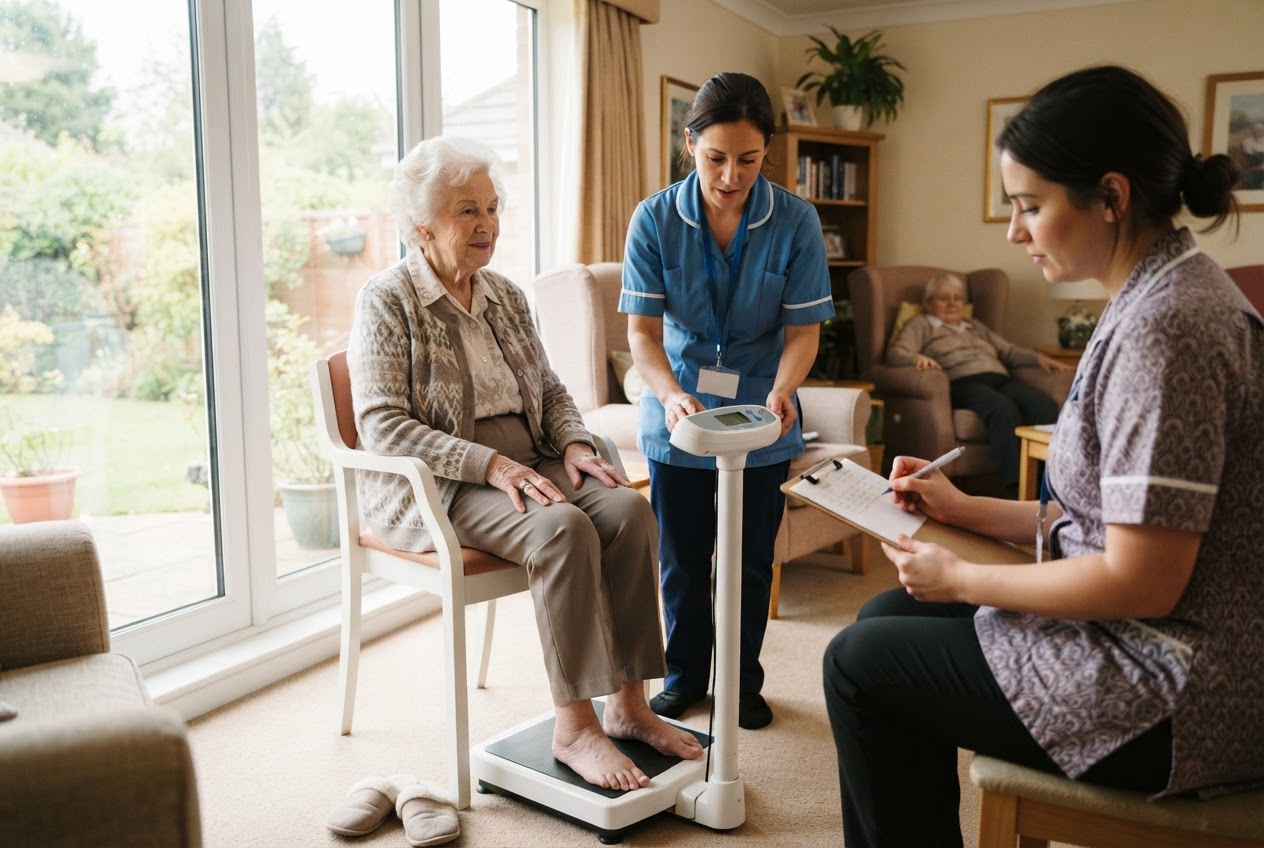
- Care staff weigh people, keep food and fluid charts, support people to eat and drink, and report changes such as weight loss or a poor appetite. Where your policy allows and they have been trained, they may complete MUST.
- Nurses or trained senior staff usually complete or check the screen, update the care plan and decide on referral.
- GPs and dietitians assess people at high risk in full, set a nutrition plan and arrange prescribed supplements where needed.
- Speech and language therapists assess swallowing and set texture-modified diets.
In homes without nurses, your policy should name who has been trained to complete MUST and how referrals reach the GP or dietitian.
How Kasorb can help
A screening score only helps if people then eat and drink well. Our Nutrition and Hydration training is for care and kitchen staff alike. It isn't a MUST course: it covers food groups and how the body uses them, vitamins and minerals, portion sizes, types of diet, hydration and the dangers of dehydration, barriers to eating and drinking well, choice and cultural differences in diet.
It runs on-site or live online in half a day, at one flat rate for the group, and two sessions can run in one day at no extra cost. Certificates of completion are emailed the next day and are valid for three years. It isn't a regulated qualification.
This guide is for awareness. Use BAPEN's full tool and follow your local policy and each person's care plan.
FAQs
What is a MUST score?
It's the total from the Malnutrition Universal Screening Tool, developed by BAPEN for adults. Points are added for low BMI, unplanned weight loss in the last 3 to 6 months and acute illness with no intake for over 5 days. 0 is low risk, 1 is medium risk and 2 or more is high risk.
What does a MUST score of 1 mean?
Medium risk. BAPEN's guidance is to observe: record what the person eats and drinks for 3 days. If intake is adequate, repeat screening at least monthly in a care home. If it isn't, follow local policy, set goals to improve intake and review the care plan regularly.
What does a MUST score of 2 mean?
High risk of malnutrition. BAPEN's guidance is to treat: refer to a dietitian or nutrition support team, or follow your local policy, set goals to improve and increase intake, and review the care plan monthly in a care home. The exception is where treatment would do harm or bring no benefit.
How often should MUST be done in a care home?
NICE says on admission and whenever there is clinical concern, such as weight loss, poor appetite, fragile skin or swallowing problems. NICE's quality standard and BAPEN's guidelines both point to repeating it monthly. Your local policy may ask for it more often.
Is there a MUST score calculator?
Yes. BAPEN publishes an online MUST calculator on its website, alongside the full tool. A calculator only works as well as the measurements you put in, so accurate, recorded weights and trained staff still matter.
On-site training for your whole team at one flat rate. See what's covered, prices and how to book.
See the course

Book a free 15-min consult call with us. We’ll help you get your mandatory training done right.