Northern Ireland Care Home Training Gap Index 2026
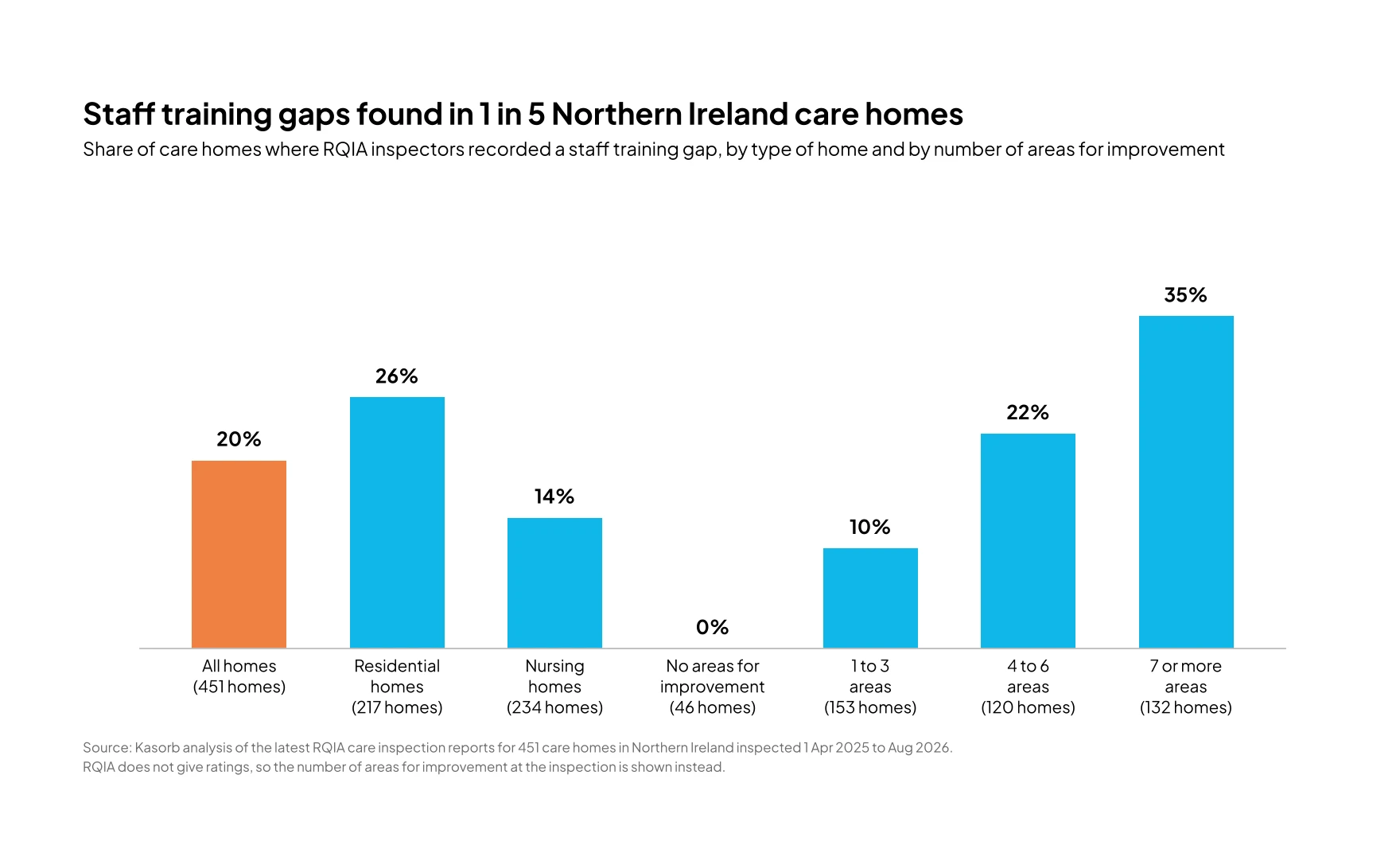

The Regulation and Quality Improvement Authority (RQIA) inspects every care home in Northern Ireland and publishes a report with a Quality Improvement Plan listing areas for improvement. We read the latest care inspection report for every home inspected between 1 April 2025 and August 2026: 451 homes. In about 1 in 5, inspectors recorded a gap in staff training. Residential homes were nearly twice as likely as nursing homes to have one.
Key findings
- Inspectors recorded a staff training gap at 20% of care homes in Northern Ireland (89 of 451): training missing or out of date, induction not completed, or competency assessments not done.
- Residential homes 26% (57 of 217) against nursing homes 14% (32 of 234), with the same average number of areas for improvement.
- The more areas for improvement a home had, the more likely a training gap: none of the 46 homes with no areas for improvement, 10% with 1 to 3 (16 of 153), 22% with 4 to 6 (27 of 120) and 35% with 7 or more (46 of 132).
- Inspectors wrote the gap into the Quality Improvement Plan as an area for improvement at 17% of homes (77 of 451).
- At 12 homes, an area for improvement about staff training was being stated for the second time: the home had been told to fix it at the previous inspection and hadn't.
- The most common gap was induction (27 homes, at least 12 of them involving agency staff), followed by fire safety training (16), competency assessments for the person left in charge of the home (12), Deprivation of Liberty Safeguards (9), moving and handling (9) and first aid or basic life support (8).
What the regulations require
Regulation 20 of both the Residential Care Homes Regulations (Northern Ireland) 2005 and the Nursing Homes Regulations (Northern Ireland) 2005 requires the registered person to make sure staff receive "appraisal, mandatory training and other training appropriate to the work they are to perform". When inspectors find shortfalls, they add an area for improvement to the home's Quality Improvement Plan, under a Regulation or a Care Standard, and check it at the next inspection.
What the training gaps were about
Induction came first, often agency staff working in the home without a completed, signed-off induction record. Fire safety training was next, then competency and capability assessments for the senior member of staff left in charge of the home when the manager is away. Deprivation of Liberty Safeguards, moving and handling, first aid and basic life support, and falls followed.

What inspectors wrote, from four of the reports (no home is named):
- "A review of records evidenced that inductions for agency staff were not fully completed or robust, for example signatures and dates were missing."
- "A review of the person left in charge of the home in absence of the manager competency and capability assessments highlighted that these were overdue for review."
- "…it was evident that some staff were outstanding Deprivation of Liberty Safeguard (DoLS) training"
- "A review of training records evidenced that infection prevention and control training had not been delivered to staff within the last year."
More on fire safety awareness training, fire marshal training, Mental Capacity Act training, moving and positioning training, basic life support training and falls prevention training.
By health and social care trust
By the trust area the home is in: Belfast 23 of 83; Northern 22 of 120; South Eastern 23 of 108; Southern 13 of 73; Western 8 of 65. The ranges overlap, so this is not a ranking.
What to check
Built from what inspectors wrote, not from Kasorb's courses:
- Every new and agency member of staff completes an induction, signed off and dated, before working unsupervised.
- Competency and capability assessments are in place and current for everyone who is left in charge of the home.
- Anyone in charge on a shift, including nights, is competent to give medication if that is part of the role.
- Fire safety, moving and handling, DoLS and first aid training are in date, and the training matrix is kept up to date.
- Areas for improvement about training are closed before the next inspection.
How we did it
- Took RQIA's register of care homes (June 2026): 469 homes, 243 nursing and 226 residential.
- Downloaded the latest care inspection report for each from rqia.org.uk (461 available) and kept the 451 homes inspected between 1 April 2025 and August 2026.
- From each report, took every sentence about training, competence, induction, refreshers, mandatory training, supervision or drills, plus the full Quality Improvement Plan.
- Coded each home against a written guide using AI-assisted text analysis. A training gap counts when inspectors found training missing or out of date, induction not completed, or competency assessments not done. RQIA's standard line that staff were well trained, anything only in the provider's response, and areas for improvement carried forward without review don't count.
- Every home was coded twice, independently. The two codings agreed on the training gap code for 98.4% of homes (kappa 0.95); the 7 differences were settled against the guide, conservatively.
Limits. These figures count what inspectors wrote, so a home with no training finding may still have gaps. RQIA does not give ratings, so the number of areas for improvement is used as a guide to how a home was doing. The 95% confidence interval for the headline figure is 16.3% to 23.7%. Northern Ireland's regulator, standards and reports differ from England's, Scotland's and Wales's, so the figures are shown side by side, not ranked. A training gap is a shortfall recorded at inspection, not a finding that anyone was harmed.
Data and credits
- Download the data (CSV): figures by type of home, areas for improvement and trust area, with confidence intervals, and the subjects named. No home or provider is named.
- Cite as: Kasorb (2026), Northern Ireland Care Home Training Gap Index 2026, kasorb.com/blog/northern-ireland-care-home-training-gap-index.
- Based on RQIA inspection reports. Quotes are attributed to RQIA. This analysis is Kasorb's, not RQIA's.
- Author: Steve van de Worp, Head of Learning, Kasorb.
- See also: CQC Training Gap Index 2026 for care homes in England, Scotland Care Home Training Gap Index 2026, Wales Care Home Training Gap Index 2026.
FAQs
What training do care home staff in Northern Ireland need by law?
Regulation 20 of the Residential Care Homes Regulations (Northern Ireland) 2005 and of the Nursing Homes Regulations (Northern Ireland) 2005 requires staff to receive appraisal, mandatory training and other training appropriate to the work they are to perform.
How often do RQIA inspectors find staff training gaps in care homes?
In about 1 in 5 care homes: 89 of the 451 homes inspected between April 2025 and August 2026 (20%).
Are training gaps more common in residential or nursing homes?
Residential homes. Inspectors recorded a training gap at 26% of residential homes and 14% of nursing homes.
What staff training is most often missing in Northern Ireland care homes?
Induction (27 homes), followed by fire safety training (16), competency assessments for the person left in charge (12), Deprivation of Liberty Safeguards (9), moving and handling (9) and first aid or basic life support (8).
Will this be updated?
Yes, every year, at the same address.
On-site training for your whole team at one flat rate. See what's covered, prices and how to book.
See the course

Not sure which course your team needs? Tell us about your setting and we'll confirm within 48 hours.