Scotland Care Home Training Gap Index 2026


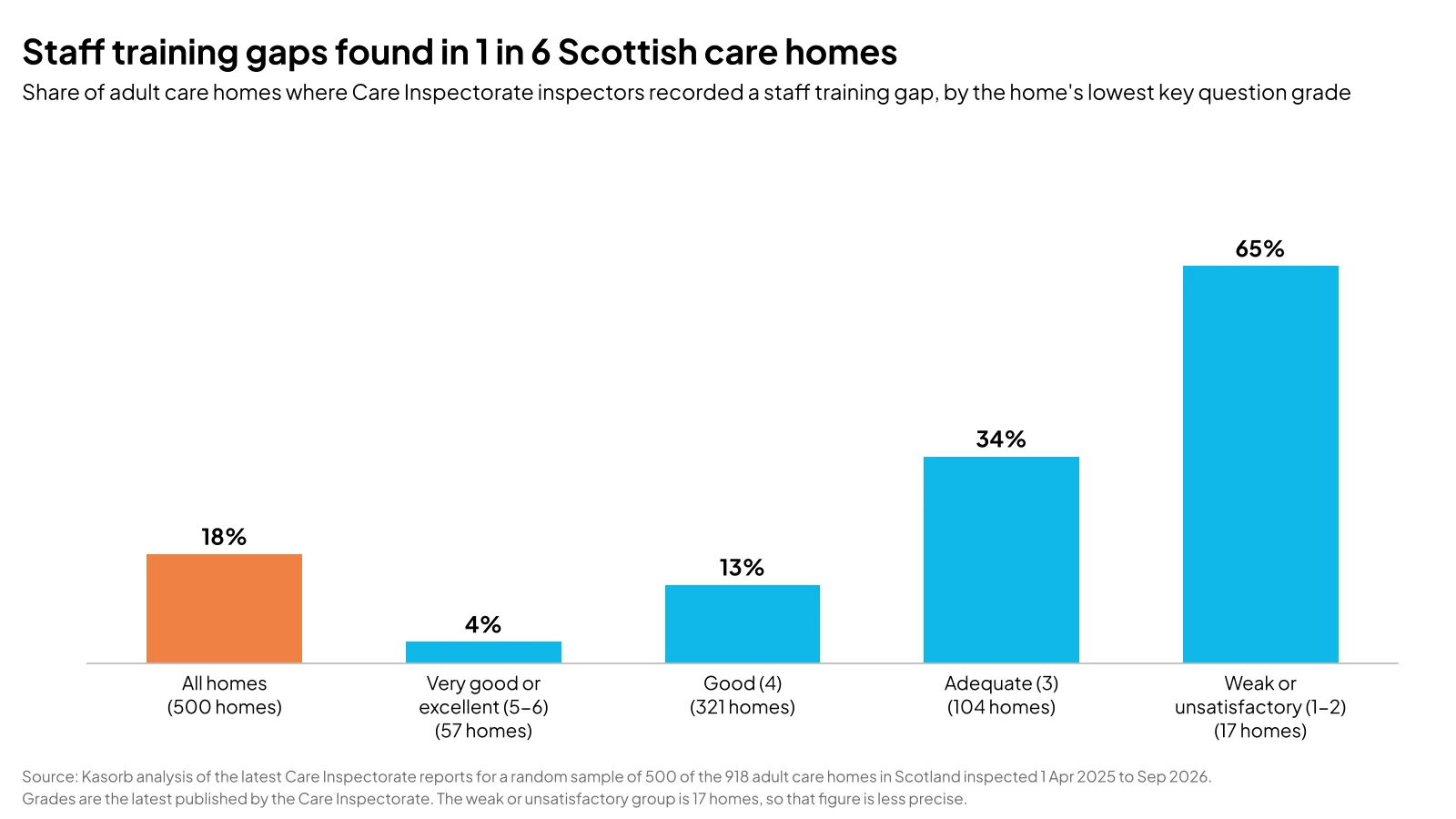
The Care Inspectorate inspects every care home in Scotland and publishes a report. We read the latest inspection reports for a random sample of 500 of the 918 adult care homes inspected between 1 April 2025 and September 2026. In about 1 in 6, inspectors recorded a gap in staff training. Where a home's lowest grade was adequate, it was about 1 in 3, and where it was weak or unsatisfactory, about 2 in 3.
Key findings
- Inspectors recorded a staff training gap at 18% of the sampled care homes (89 of 500): training missing, out of date or overdue, induction not completed, or competency checks and observations of practice not done.
- The lower the grades, the more common the gap: 4% of homes graded very good or excellent throughout (2 of 57), 13% where the lowest grade was good (41 of 321), 34% adequate (35 of 104) and 65% weak or unsatisfactory (11 of 17).
- Half of homes whose staff team was graded adequate had a training gap (30 of 59), against 19% graded good (42 of 226) and 7% graded very good (15 of 203).
- Inspectors made a requirement or an area for improvement about staff training at 14% of homes (68 of 500).
- The two most common gaps were competency checks and observations of staff practice not done or lapsed (29 homes), and general mandatory training or refreshers (29). Next came medication (14), infection prevention and control (11) and dementia (11).
What the regulations require
Regulation 15 of the Social Care and Social Work Improvement Scotland (Requirements for Care Services) Regulations 2011 requires providers to make sure staff "receive training appropriate to the work they are to perform". Standard 3.14 of the Health and Social Care Standards says: "I have confidence in people because they are trained, competent and skilled, are able to reflect on their practice and follow their professional and organisational codes." Inspectors cite it in many of their areas for improvement on training.
What the training gaps were about
Competency checks and observations of staff practice came up as often as overdue courses. Inspectors found observations of practice not happening, medication competency not assessed, or records of "reflective accounts" in place of direct observation. Medication, infection prevention and control, dementia, safeguarding (adult support and protection), induction, fire safety, stress and distress, and nutrition and dysphagia followed.

What inspectors wrote, from four of the reports (no home is named):
- "Overall compliance with mandatory training did not meet the provider's expected standards."
- "The service had recently transferred to a new competency-based assessment tool, which meant that some competency assessments were overdue."
- "The majority of staff dispensing medication had not completed the required training courses within the stated timescales to be classed as competent to administer medication."
- "We remained concerned about staff knowledge and practice in relation to nutrition, hydration and food safety."
More on medication administration training, infection control training, dementia awareness training, safeguarding adults training, positive behaviour support training and dysphagia training.
Who runs the home
Training gaps were recorded at 17% of privately run homes in the sample (56 of 335), 13% of voluntary or not-for-profit homes (14 of 104) and 33% of council-run homes (18 of 55). The council group is small, so treat that difference with caution (95% confidence interval 22% to 46%).
By health board area
For health board areas with at least 40 homes in the sample: Greater Glasgow and Clyde 6 of 80; Lothian 10 of 70; Tayside 11 of 56; Grampian 12 of 55; Lanarkshire 12 of 47; Highland 12 of 44; Ayrshire and Arran 4 of 43. These are samples, the ranges overlap, and they are not a ranking.
What to check
Built from what inspectors wrote, not from Kasorb's courses:
- Mandatory training and refreshers are tracked, in date and recorded.
- Competency assessments and observations of practice are planned, done and written up for every member of staff, not just the training certificate.
- Medication competency is reassessed regularly, including when a new system is introduced.
- New and agency staff complete an induction before working alone.
- Training covers the conditions of the people living in the home, such as dementia, stress and distress, and eating and drinking.
- Requirements and areas for improvement about training are closed before the next inspection.
How we did it
- Took the Care Inspectorate's datastore of registered care services (30 September 2026) and selected the 982 active care homes for adults.
- Downloaded the latest inspection report for each (942 available) and kept the 918 homes inspected on or after 1 April 2025. Drew a random sample of 500.
- From each report, took every sentence about training, competence, induction, refreshers, mandatory training, supervision or observations of practice, plus every requirement and area for improvement in full, including whether earlier ones had been met.
- Coded each home against a written guide using AI-assisted text analysis. A training gap counts when inspectors found training missing, out of date or overdue, induction not completed, or competency checks not done, even if the home put it right after inspectors raised it. Earlier requirements found met, plans, and positive mentions don't count.
- A second, independent coding of 125 homes agreed on the training gap code for 124 (kappa 0.96). The one difference came from a cut-off report extract; those reports were re-read in full and recoded.
Limits. These figures count what inspectors wrote, so a home with no training finding may still have gaps. This is a random sample: the 95% confidence interval for the headline figure is 14.7% to 21.4%. Follow-up inspections, which look at fewer areas, are included. Grades are the latest published by the Care Inspectorate. Scotland's regulator, framework and reports differ from England's, Wales's and Northern Ireland's, so the figures are shown side by side, not ranked. A training gap is a shortfall recorded at inspection, not a finding that anyone was harmed.
Data and credits
- Download the data (CSV): figures by grade, provider type, client group and health board, with confidence intervals, and the subjects named. No home or provider is named.
- Cite as: Kasorb (2026), Scotland Care Home Training Gap Index 2026, kasorb.com/blog/scotland-care-home-training-gap-index.
- Based on Care Inspectorate inspection reports and data. Quotes are attributed to the Care Inspectorate. This analysis is Kasorb's, not the Care Inspectorate's.
- Author: Steve van de Worp, Head of Learning, Kasorb.
- See also: CQC Training Gap Index 2026 for care homes in England, Wales Care Home Training Gap Index 2026, Northern Ireland Care Home Training Gap Index 2026.
FAQs
What training do care home staff in Scotland need by law?
Regulation 15 of the Social Care and Social Work Improvement Scotland (Requirements for Care Services) Regulations 2011 requires providers to make sure staff receive training appropriate to the work they are to perform. Standard 3.14 of the Health and Social Care Standards says people should have confidence in staff because they are trained, competent and skilled.
How often do Care Inspectorate inspectors find staff training gaps in care homes?
In about 1 in 6 adult care homes: 89 of a random sample of 500 homes inspected between April 2025 and September 2026 (18%).
Are training gaps more common in care homes with lower grades?
Yes. Inspectors recorded a training gap at 4% of homes graded very good or excellent throughout, 13% where the lowest grade was good, 34% adequate and 65% weak or unsatisfactory.
What staff training is most often missing in Scottish care homes?
Competency checks and observations of staff practice (29 homes) and general mandatory training or refreshers (29), followed by medication (14), infection prevention and control (11) and dementia (11).
Will this be updated?
Yes, every year, at the same address.
On-site training for your whole team at one flat rate. See what's covered, prices and how to book.
See the course

Not sure which course your team needs? Tell us about your setting and we'll confirm within 48 hours.