Yankauer Suction: A Guide to Oral Suction in Care
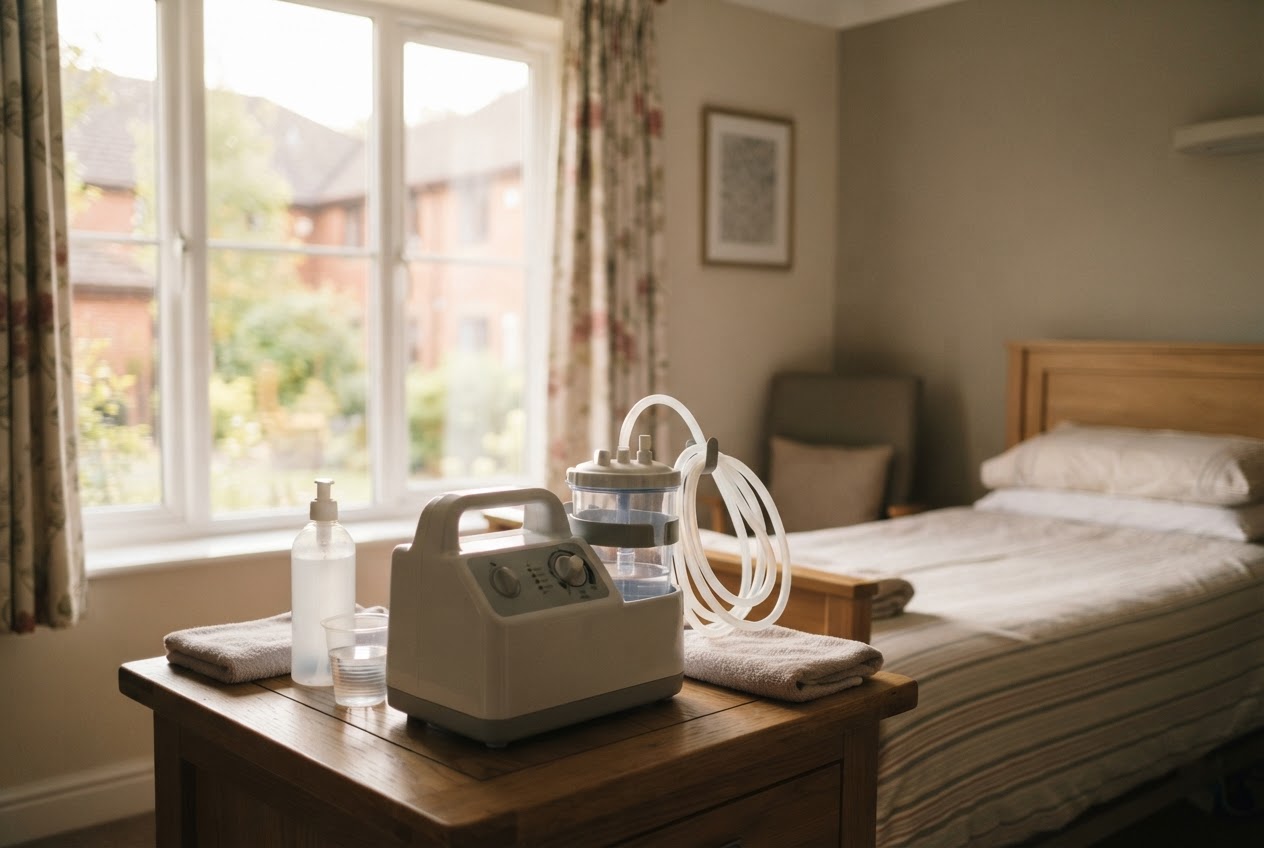

A Yankauer is a rigid plastic suction tip, attached by tubing to a suction machine, used to clear saliva and other secretions from a person's mouth. Its rounded head and side holes are designed to clear fluid without damaging the soft tissue around it. In care settings it is used for people who can't clear their own mouth, following their care plan.
This is awareness-level information, not a procedure. Follow your local policy and the person's care plan.
What a Yankauer is
The Yankauer is named after Sidney Yankauer, a New York ear, nose and throat surgeon who designed it in the early 1900s. It is a curved, wide-bore plastic tube with a bulbous head and one or more side openings. That design lets it remove thick fluid quickly while the rounded head protects the gums, tongue and cheeks.
Many Yankauers have a small vent near the handle. Suction only reaches the tip when you cover the vent with a thumb, so you control exactly when it pulls.
A Yankauer is different from a soft, flexible suction catheter. Flexible catheters can reach further and are used for deeper airway suction, including through a tracheostomy, which is a specialist skill with its own training. Our tracheostomy care training covers that separately.
How a suction machine works
Every suction set-up has the same basic parts:
- A vacuum source: in a hospital this is often a wall unit connected to the building's piped supply. In care homes and people's own homes it is usually a portable electric machine with a rechargeable battery.
- A collection canister: the fluid you remove ends up here, not in the machine.
- A filter: protects the machine. It is replaced as the manufacturer directs, and whenever it gets wet.
- Tubing: long, flexible tubing connects the canister to the Yankauer.
- A pressure control and gauge: the suction pressure is set according to the manufacturer's instructions and your local policy. Staff shouldn't change it beyond what the policy says.
Cambridge University Hospitals' patient guidance on oral suction at home stresses keeping the unit charged, and notes its machines are recalled each year for servicing and a filter change.
When oral suction is used in care
Oral suction is a comfort and safety measure for people who can't manage the saliva or secretions in their own mouth. NHS guidance for patients and carers describes it being used:
- where a weak swallow or cough means saliva pools in the mouth, for example in motor neurone disease
- to reduce drooling and keep the mouth comfortable
- as part of mouth care for someone with a poor swallow
- when gurgling during breathing suggests secretions have collected in the mouth
If your team supports people with swallowing difficulties, our dysphagia awareness training covers the wider picture of safe eating, drinking and mouth care.
Who can carry out oral suction depends on your policy and how clinical tasks are handed over in your service. One NHS community trust's 2020 procedure, for example, allowed support workers to do it only once they had been trained, assessed and formally given the task by a registered professional.
Safety principles staff should understand
Hands-on training and local sign-off are what make staff safe to do this. At awareness level, the principles that run through NHS guidance are:
- Consent and explanation: explain what you are about to do and agree how the person can tell you to stop. Where someone lacks capacity, follow your capacity and best-interests processes.
- Position: the person should be sitting up or lying on their side, as set out in their care plan.
- Stay in the mouth: oral suction clears what you can see. Keeping the tip forward, around the cheeks and over the tongue, avoids triggering the gag reflex.
- Short bursts: suction briefly, within the time limit your policy sets, and let the person rest between attempts.
- Never for choking: NHS guidance is clear that suction should not be used to try to remove a solid object from the back of the throat, as this can push it further down. Follow your choking procedure instead.
- Stop if something is wrong: gagging, vomiting, bleeding, distress or changes in breathing all mean stop and get help.
Equipment checks
Suction is often needed quickly, so a machine that fails is a real risk. A routine check, as often as your policy sets, typically covers:
- the battery is charged, or the machine is on charge
- the machine switches on and pulls suction
- the canister is empty, clean and fitted correctly
- the filter is dry and has been changed on schedule
- tubing is intact, with no cracks or kinks
- a clean, covered Yankauer and spare tubing are within reach
- the service date is current
Record each check. If a machine develops a fault, take it out of use and follow your equipment procedure. Anyone can also report a problem with a medical device to the MHRA through the Yellow Card scheme.
Infection control
The basics matter:
- Clean your hands before and after, and wear the protective equipment your policy requires.
- Keep each person's suction equipment for that person only.
- Rinse the tubing through with water after use, and keep the Yankauer covered when it isn't in use.
- Empty and clean the canister as your policy and the manufacturer direct, and dispose of the contents safely.
- Replace Yankauers, tubing and filters on schedule, or sooner if they are dirty or damaged.
Replacement schedules vary. One NHS trust's guidance says to change the Yankauer depending on how often it's used, while another trust's guidance for people at home suggests reusable Yankauers and tubing can last a month if properly cleaned and stored. Your local policy and the manufacturer's instructions decide which applies. For the wider principles, see our infection control training.
Complications to report
Oral suction is normally very safe when done properly, but report and record:
- bleeding from the gums or mouth, or a sore, damaged mouth
- gagging or vomiting, because of the risk of breathing vomit into the lungs
- distress, or the person breathing faster or with difficulty
- a change in the colour, thickness or amount of secretions, which may mean the person needs a medical review
- needing to suction much more often than usual
Record when you suctioned, what you removed and how the person was afterwards. Good records help the nurse or GP spot a change early.
How Kasorb can help
Our oral suctioning training is delivered on-site anywhere in the UK for up to 10 staff, so everyone gets hands-on practice. It covers why and when oral suctioning is needed, anatomy of the mouth and upper airway, equipment and safe set-up, technique and safe suction pressures, infection control, complications and emergencies, and documentation. Staff practise technique under the trainer's observation, with feedback, using the suction equipment agreed with you when you book.
Your trainer has used these skills for real and keeps the focus on safe technique and knowing when to stop and escalate. It's one price for the group, quoted for your location. Each person receives a Kasorb certificate of completion, emailed the next day, and your own supervised sign-off against your policies completes the process before staff suction on their own.
FAQs
What is a Yankauer used for?
A Yankauer is a rigid plastic suction tip used with a suction machine to clear saliva and other secretions from the mouth. In care settings it helps people who can't clear their own mouth, such as people with a weak swallow, and it is often used as part of mouth care.
What is the difference between a Yankauer and a suction catheter?
A Yankauer is rigid, with a rounded head designed for clearing the mouth without damaging soft tissue. A suction catheter is soft and flexible, and can reach further into the airway, for example through a tracheostomy. Deeper suction is a separate skill that needs its own training and policy.
How often should a Yankauer be changed?
It depends on your local policy and the manufacturer's instructions, and NHS guidance varies. One NHS trust says to change it depending on how often it's used, while another suggests reusable ones at home can last a month if properly cleaned. Always replace a Yankauer sooner if it is dirty or damaged.
Can care workers do oral suction?
It depends on your service's policy and how clinical tasks are handed over. Where care workers carry out oral suction, they need training, practice and a supervised sign-off against your policies first. The person's care plan should say whether suction is needed, how and by whom.
Can you use a suction machine on someone who is choking?
NHS guidance on oral suction says suction should not be used to try to remove a solid object from the back of the throat, because it can push the object further down. Follow your choking procedure and basic first aid instead, and call for help.
On-site training for your whole team at one flat rate. See what's covered, prices and how to book.
See the course

Not sure which course your team needs? Tell us about your setting and we'll confirm within 48 hours.