Ofsted Children's Homes Training Gap Index 2026
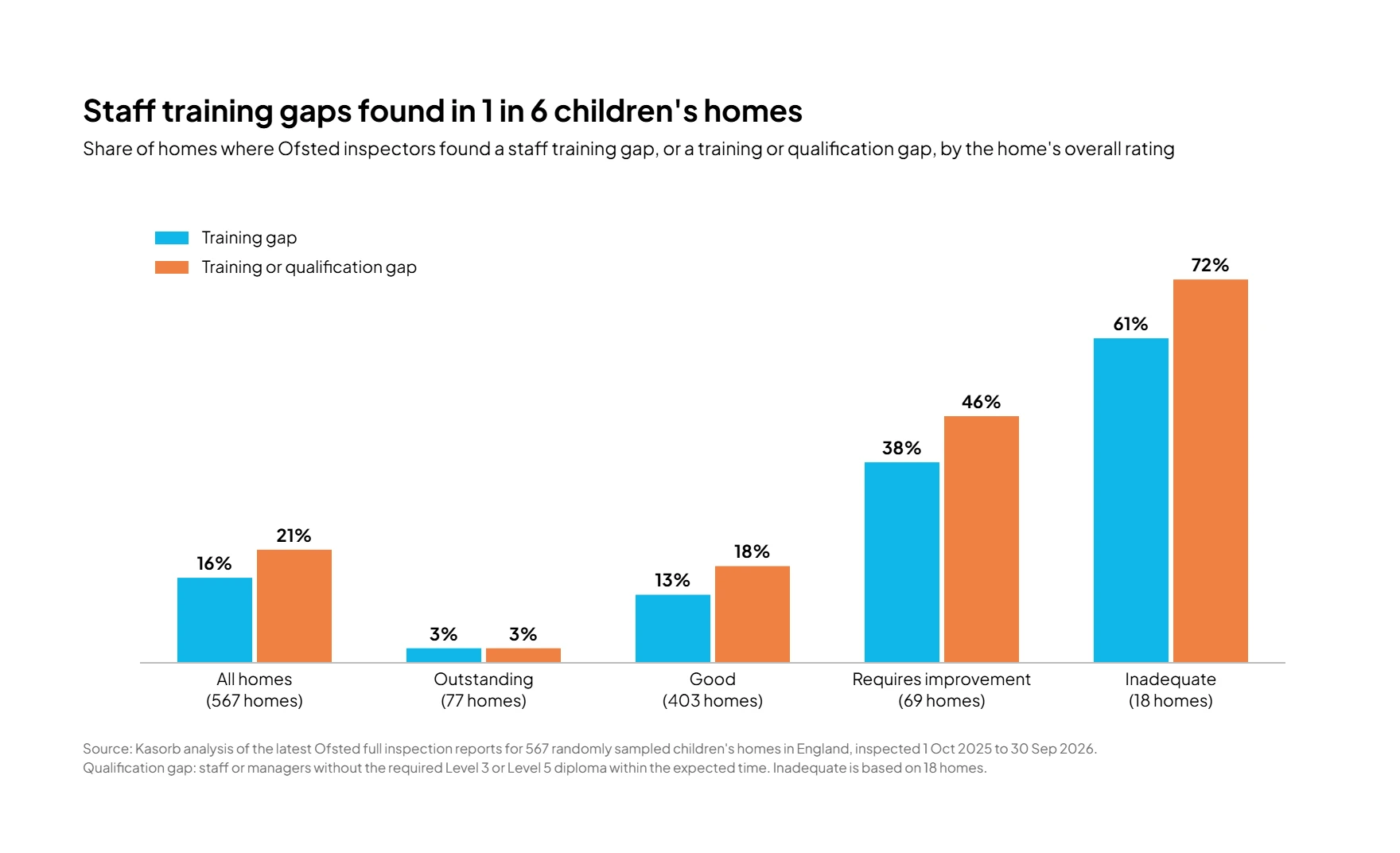

Ofsted inspects every children's home in England and publishes a report. We read the latest full inspection reports for 567 randomly sampled children's homes, inspected between 1 October 2025 and 30 September 2026. In about 1 in 6, inspectors found a gap in staff training. In homes rated requires improvement it was about 4 in 10, and in homes rated inadequate about 6 in 10.
Key findings
- Inspectors found a staff training gap in 16% of children's homes (90 of 567): training missing, out of date, not matched to the children's needs, induction not done, or training not monitored.
- Including staff or managers who hadn't gained the required diploma in time, 21% had a training or qualification gap (120 of 567), about 1 in 5.
- The weaker the rating, the more common the gap: 3% of homes rated outstanding (2 of 77), 13% rated good (51 of 403), 38% rated requires improvement (26 of 69) and 61% rated inadequate (11 of 18).
- Across homes rated requires improvement or inadequate, 43% had a training gap (37 of 87), and 52% a training or qualification gap (45 of 87).
- Inspectors set a formal requirement about staff training, qualifications or skills at 17% of homes (96 of 567).
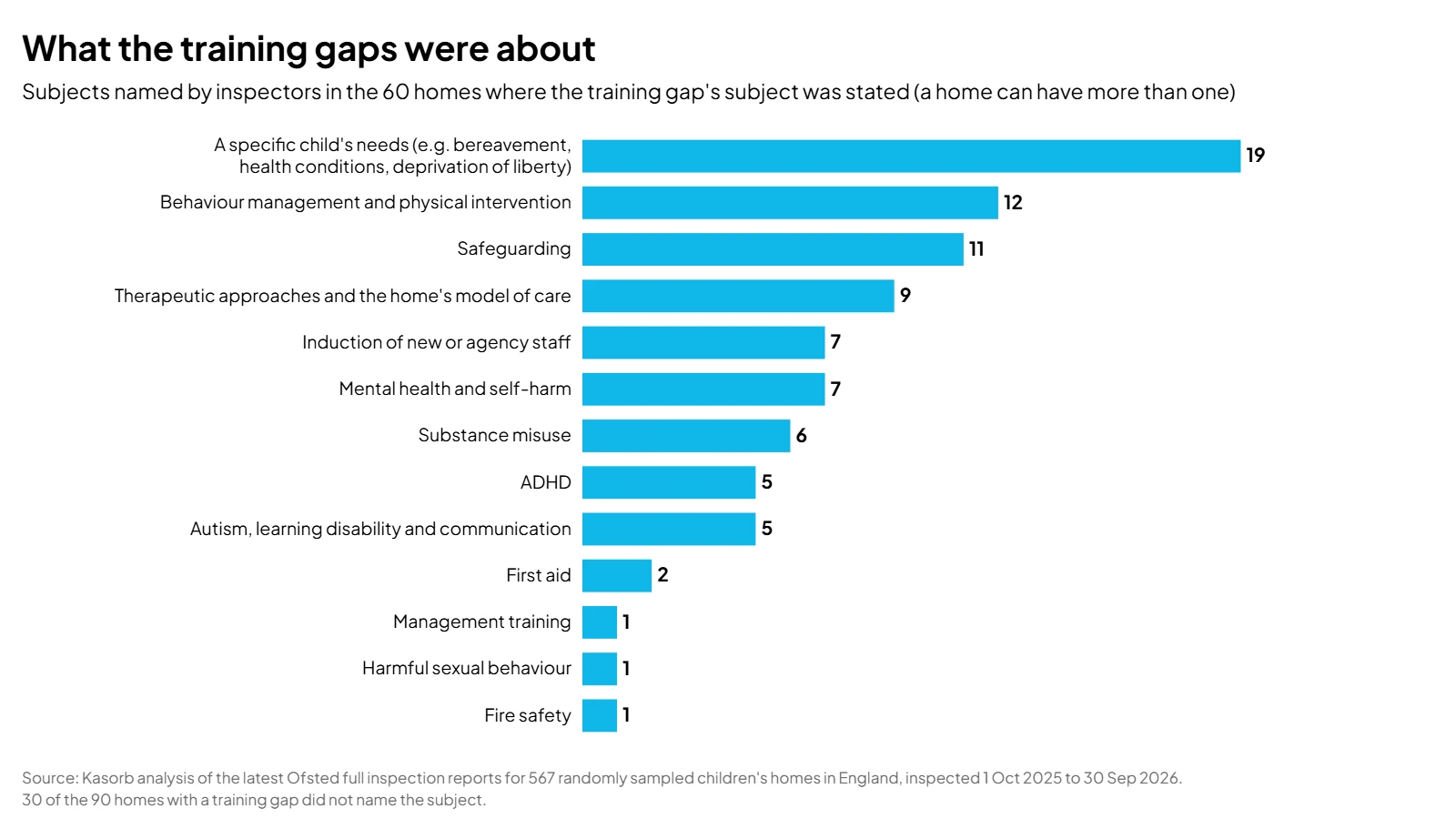
- The most common subjects were the needs of a specific child (19 homes), behaviour management and physical intervention (12), safeguarding (11) and the home's therapeutic approach or model of care (9).
What the regulations require
The Children's Homes (England) Regulations 2015 set out what staff need. Regulation 33 says every employee must have a suitable induction and must "undertake appropriate continuing professional development". Regulation 32 says staff in care roles must gain the Level 3 Diploma for Residential Childcare, or an equivalent, within 2 years of starting. Regulation 28 says the registered manager must gain the Level 5 Diploma in Leadership and Management for Residential Childcare within 3 years of starting to manage a home.
Regulation 13, the leadership and management standard, also requires the registered person to "ensure that staff have the experience, qualifications and skills to meet the needs of each child". When inspectors find this isn't happening, they can set a requirement with a date by which it must be put right.
What the training gaps were about
60 of the 90 homes with a training gap had the subject named in the report. The most common was training for the needs of a particular child, such as a health condition, bereavement or a deprivation of liberty order. Next came behaviour management and physical intervention, safeguarding (including exploitation and children going missing), and the home's own therapeutic approach. Mental health and self-harm, substance misuse, ADHD, and autism and communication each came up at 5 to 7 homes.
What inspectors wrote, from four of the reports (no home is named):
- "However, most staff have not completed substance misuse training, despite children having known histories of drug use."
- "Some have not completed self-harm training, despite some children displaying self-harming behaviours."
- "However, not all staff have received training in alternative methods of communication."
- "For example, some staff members' safeguarding and fire safety refresher training is overdue."
In 16 of the 90 homes, inspectors also said training records or monitoring weren't good enough to show who had been trained in what.
More on therapeutic parenting training, trauma-informed care training, positive behaviour support training, working with self-harm training, ADHD awareness training, autism awareness training and harmful sexual behaviour training.
Qualifications
At 41 homes (7%), inspectors found staff or managers who hadn't gained the required Level 3 or Level 5 diploma within the expected time. Together with training gaps, that makes 120 homes (21%) with a training or qualification gap.
Who runs the home
Training gaps were found at 16% of privately run homes (75 of 482), 15% of local authority homes (9 of 59) and 23% of voluntary sector homes (6 of 26). The local authority and voluntary groups are small, so these differences aren't meaningful.
What to check
Built from what inspectors wrote, not from Kasorb's courses:
- Every new member of staff, including agency staff, completes an induction.
- When a child moves in, their plan sets out any training staff need to meet that child's needs, and it's done.
- Staff are trained in the home's own therapeutic approach or model of care, not just told about it.
- Training covers the risks the children actually face, such as self-harm, substance misuse, exploitation and going missing.
- Staff are on track for the Level 3 Diploma within 2 years, and the registered manager for the Level 5 Diploma within 3 years.
- Refresher training is tracked, and records show who was trained, when and in what.
How we did it
- Took Ofsted's official list of children's homes registered at 30 September 2025 (4,394 homes), shuffled it at random and took the first 700.
- For each, downloaded the latest full inspection report from reports.ofsted.gov.uk and kept the 567 homes whose latest full inspection was between 1 October 2025 and 30 September 2026. Ratings in the sample: outstanding 77, good 403, requires improvement 69, inadequate 18.
- From each report, took every sentence about training, induction, qualifications, skills, knowledge or professional development, plus all the requirements and recommendations.
- Coded each home against a written guide using AI-assisted text analysis. A training gap counts when inspectors found training missing, out of date, insufficient or not matched to children's needs, induction not done, or training not monitored, even if the home put it right after inspectors raised it.
- A second, independent coding of 211 homes (a random 60, every home with a gap, and every home rated requires improvement or inadequate) agreed on the training gap code for 209 (kappa 0.98). Disagreements were settled conservatively: a gap counts only where the report clearly states one. Every figure was then recalculated independently from the coded data.
Limits. These figures count what inspectors wrote. A home with no training finding may still have gaps, so this is likely an undercount. Homes with weaker ratings are inspected more often, and we used each home's latest full inspection, so the sample reflects homes inspected in the year. Only 18 homes were rated inadequate, so that figure is less precise (95% confidence interval 39% to 80%). 30 of the 90 homes with a training gap didn't have the subject named. This covers England only. A training gap is a shortfall recorded at inspection, not a finding that a child was harmed.
Data and credits
- Download the data (CSV): figures by rating and sector, with confidence intervals, and the subjects named. No home or provider is named.
- Cite as: Kasorb (2026), Ofsted Children's Homes Training Gap Index 2026, kasorb.com/blog/childrens-homes-training-gap-index. Reports read 28 October 2026.
- Contains Ofsted data and report text, © Crown copyright, used under the Open Government Licence v3.0. This analysis is Kasorb's, not Ofsted's.
- Author: Steve van de Worp, Head of Learning, Kasorb.
- See also: CQC Training Gap Index 2026 for care homes, CQC Learning Disability Training Gap Index 2026, Coroners' Reports Staff Training Index 2026 and Fire Safety Training Enforcement Index 2026.
FAQs
What training do children's home staff need by law?
Under the Children's Homes (England) Regulations 2015, every employee must have a suitable induction and appropriate continuing professional development (regulation 33). Staff in care roles must gain the Level 3 Diploma for Residential Childcare, or an equivalent, within 2 years of starting (regulation 32), and the registered manager the Level 5 Diploma within 3 years (regulation 28).
How often do Ofsted inspectors find staff training gaps in children's homes?
In about 1 in 6 homes: 90 of 567 children's homes inspected between October 2025 and September 2026 (16%). Including qualification gaps, it was about 1 in 5 (21%).
Are training gaps more common in homes rated requires improvement or inadequate?
Yes. Inspectors found a staff training gap at 38% of homes rated requires improvement and 61% of homes rated inadequate, compared with 13% of homes rated good and 3% rated outstanding.
What staff training is most often missing in children's homes?
Training for the needs of a particular child (19 homes), behaviour management and physical intervention (12), safeguarding (11) and the home's therapeutic approach or model of care (9), among the 60 homes where the subject was named.
Will this be updated?
Yes, every year, at the same address.
On-site training for your whole team at one flat rate. See what's covered, prices and how to book.
See the course

Not sure which course your team needs? Tell us about your setting and we'll confirm within 48 hours.